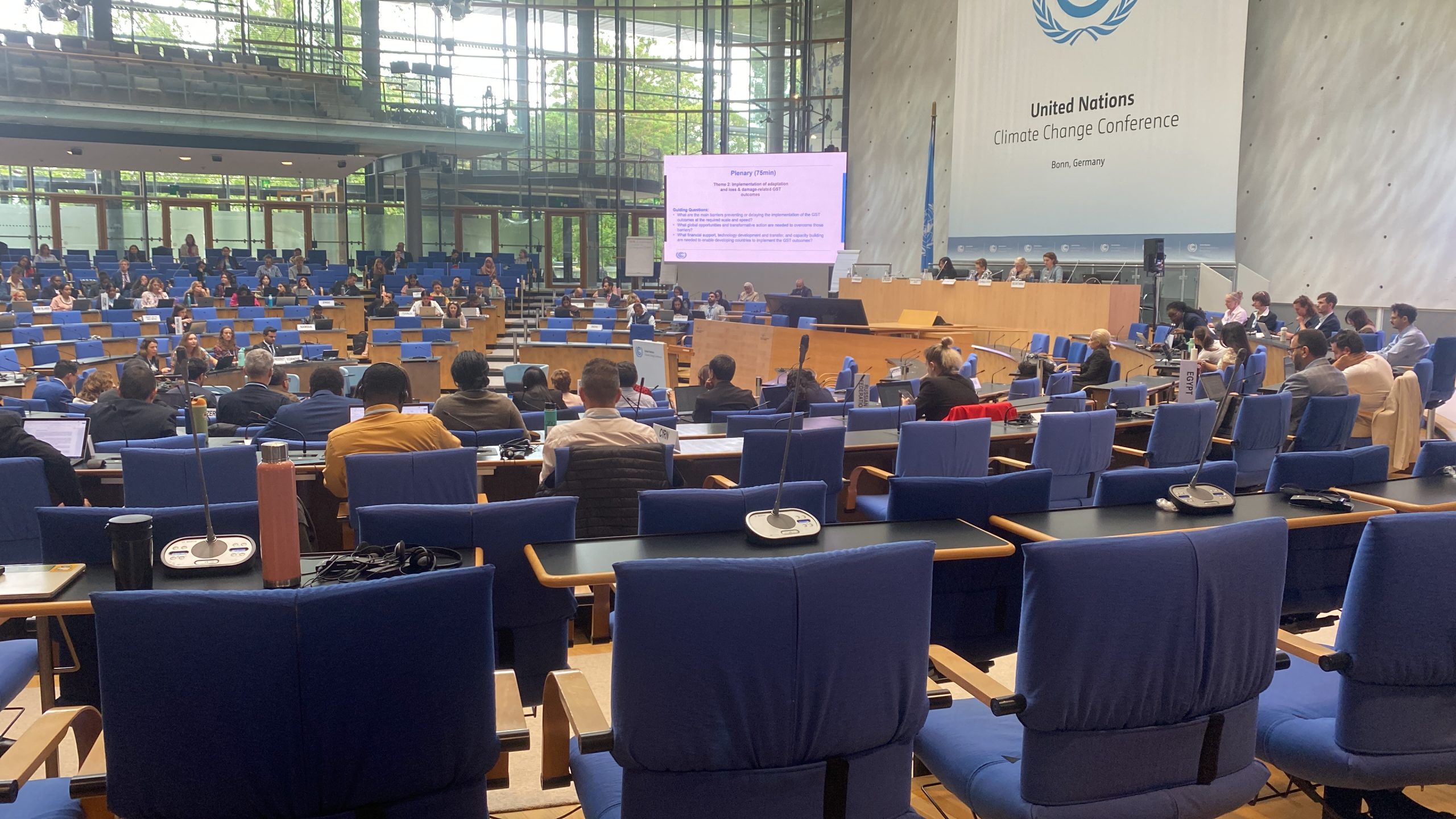
The Chamber Hall of the World Climate Conference Centre was a venue for many of the dialogues taking place at the June Climate Meetings in Bonn.
To be cited as: Hughes, Hannah. 2026. “Between Science and Vulnerability: Modes of Dialoguing in the UNFCCC”. CAMAMAZON. Available at: https://camamazon.aber.ac.uk/2026/09/22/between-science-and-vulnerability-modes-of-dialoguing-in-the-unfccc/ (accessed xx/xx/xxxx).
It’s Monday the 20th of July. In my inbox is a letter from the subsidiary body chairs providing an outline for the second global stocktake. As this process is initiated for the second time, the question of ‘what is dialogue in the UNFCCC process, and how is dialogue done?’ seem more critical than ever. I realise it’s time to return to my observations of the June Climate Meetings in Bonn, where there were a lot of dialogues taking place. But before I take us there, I want to revisit the CAMAMAZON project methodology, because this lays down the context for my reflections on modes of dialoguing in the UNFCCC.
In the project, we are taking a multi-territorial approach to our ethnographic study of climate agreement-making. This is to enable, and to ensure, that through our research we capture and hold in place the multiple territories – as shaped by diverse ways of knowing and living with the Earth – that are brought into relation and into tension with one another through the struggle over climate change and dominance in UNFCCC negotiations. Included within this multi-territorial methodology is the territory of ourselves, as researchers, which opens space for examining and reflecting on the relationship that we each hold to territory and the formation of these territorial relations over time.
This methodological approach raises questions about how and why personal experience and reflection matter to the study of international climate agreement-making. What do personal reflections and accounts within our ethnography reveal that we might not identify and document otherwise? This brings to the surface long-standing social scientific debate over the role of the observer and the place of personal reflection in observation of collective culture and social organisation.
One of the project’s new postdocs, Tchella Maso, highlighted in our methodology workshops the importance of a feminist approach to ethnography. She sent us a list of readings, which included Ruth Behar’s (1996) The Vulnerable Observer. I started to read this on my journey to Bonn. As I read, I felt that as a project team, we were already working as vulnerable observers through our conversation on territories and the reflections this has initiated on processes of de-territorialisation. However, I also wondered if there was a way to consciously attune to the negotiation spaces differently while in Bonn, is it possible to see and record beneath what is said and done? To attune to vulnerability?
I have been interested in the emotions brought into play within the negotiating room since my first COP experience. At COP23 in Bonn in November 2017, I observed negotiation of the formation of the Local Community and Indigenous Peoples Platform (LCIPP). The element that surprised me the most was the frequent reference to the feelings, emotions and the spirit in the room. At the time, I was immersed in analysing forms of power and authority, but alongside these, I was hearing the specification and even the mobilisation of the feeling in the room, as the co-faciliators curated the conditions to immerse the negotiators in their task. I began to wonder…could the affect of emotions be recorded and captured? Could this identify some of the undercurrents of agreement-making? I realised that this may require that I do something different as an observer, perhaps less writing of what people say and more observation of what I see and feel taking place in the room.
This change in approach was thrust upon me by the SB64 schedule and its very high volume of dialogues. Dialogues serve different purposes within the UNFCCC context. For example, the annual Research Dialogue is an opportunity for central interfacing international science-policy organisations, like the IPCC and WMO, to provide updates and reports on the state of the climate and forthcoming reports. There is also the opportunity for parties to ask questions and have closer engagement with the expert presenters in breakout sessions. Annual dialogues, on the other hand, like those attached to the outcome of the first Global Stocktake (GST), allow parties to share knowledge and good practices from the national context, such as how the first GST outcome is informing their next nationally determined contributions (NDC).
Dialoguing
On the SB64 overview schedule for June 2026, there were 13 dialogues listed, with a total of 77.5 hours of dialoguing over 10 days (not including other workshop formats). That’s a lot of dialogue. This reflects the stage of the Paris Agreement’s implementation – the rules of the agreement have been negotiated, now the focus has shifted to creating and maintaining the conditions to fulfil its objectives. One of the main reasons I travelled to Bonn was to observe the dialogue mandated by the outcome of the first global stocktake: The United Arab Emirates dialogue on implementing GST outcomes. I followed the negotiation of the format of this dialogue for two years, a repetitive experience. I take my seat in the Chamber Hall for the chance to gain further insight into what this negotiation was all about.
Ana Toni, COP30 CEO, provides an opening statement. She reminds the room that the global stocktake is “the engine of the Paris Agreement.” It is the central mechanism for parties to assess where they “collectively stand” in implementing the agreement and is designed to apply pressure to raise the ambition of each consecutive Nationally Determined Contribution (NDC). She identifies the outcome of the first GST as historical – providing a “shared diagnosis” and the measures needed to course correct, including transitioning away from fossil fuels, halting and reversing deforestation and enhanced support to allow for higher ambition. Within this context, the aim of the UAE dialogue is practical, it provides a “dedicated space to learn from one another” and to exchange “real experiences, barriers, needs” and to identify key enablers” to support parties in the implementation of the first GST outcome.
The dialogue begins with a presentation from the Secretariat reviewing the extent that the first GST informed NDCS. The session then prepares for three breakout sessions to give parties a more facilitative space for “mutual learning” beyond reading prepared statements. It is here that the first structural challenge to dialoguing in the UNFCCC context emerges. It turns out that while the World Climate Conference Centre is a large venue, it still has capacity limits, and these had been reached. There simply aren’t enough rooms to hold the multiple, simultaneous dialogues on the SB64 schedule. The co-facilitators propose holding the three breakout sessions in different corners of the Chamber Hall. We all know that this is impossible. The large, blue chairs are fixed to the floor in circular rows with narrow desks in front of them. Egypt wonders how groups will hear each other? Whether there will be microphones and how the discussion will be captured in the report. India also has questions about the logistics, indicating that “to speak loudly to about 100 people would stretch our vocal chords,” and instead proposes that the session continues in plenary.
This reminds me of lengthy discussion throughout the technical phase of the GST and the negotiation of this dialogue. During the GST, some parties repeatedly raised questions about the method for capturing all views during dialogue sessions. And in the negotiation of the UAE dialogue, there was considerable back and forth over whether there would be a report and if this would serve as input to the second GST.
We continue in plenary. The co-facilitator specifies the tension in the negotiating structure that we find ourselves, wanting “to hear that informality” and “to keep that spirit we see in breakouts” but also reminding delegates about the time constraints. A buzzer is introduced to keep time. Time, in the context of climate change and the session agenda, is perhaps the most significant structural constraint to dialoguing in the UNFCCC. In this room, the need to deliver all of the prepared statement reduces the proceedings to speed reading. The inevitable interruption of speakers takes me back to the Mutirão sessions at COP30. During the negotiation of the COP30 cover decision it was Tulio Andrade that was interjecting, in Bonn it’s being enforced by a beep. The effect is that delegates begin to speak so quickly that I find it impossible to even type a summary of their intervention, and most don’t even make it to the end of their prepared statement.
I begin to wonder, is anyone listening to what anyone else is saying? Maybe they don’t need to listen because they have already heard it all before, but then, why are we all in this room listening to each other? Perhaps only the researchers and the Secretariat are actively seeking to hear and record the proceedings. It seems that there may in fact be no need for that either, as speakers are reminded again to stay within the time limit and provide written submission of their statements. As the speakers speed read through their statements, I abandon note taking altogether and find my gaze pulled towards the skylight windows of the Chamber Hall.
My attention switches between the room, the speaker, the sky and a few keywords typed on the screen. Even in this posture, feet dangling over the edge of the oversized cinema chairs, laptop precariously balanced on my knees, I can’t help but notice a pattern. It’s not like the content of the interventions isn’t important; what is being said is hugely consequential. Countries are talking about hard decisions, leaving fossil fuels – seemingly quick and easy revenue for their deep development challenges – in the ground, and the financial, technology transfer and capacity building support they need to make those decisions possible. This is the content at the heart of the matter that reappears across all the dialogues I attend throughout my time in Bonn, perhaps because this is the strongest current against collective climate action. But there are different ways of talking about this subject – a discernible pattern between North and South, which when is departed from stands out.
Developed countries have a tendency to speak in general terms, frequently looking outward and distant from their own national realities and how these impact on NDC implementation. It is about the global picture, missing NDCs, encouraging other nations and collective efforts. Canada breaks this mould, reflecting that “delivering at scale is not easy”, highlighting the challenge of the low political “acceptance of climate action”, and that “public finance is a key component, but will never be enough.” In the United Kingdom, we share these experiences: the pressure on the government to re-open North Sea drilling, daily media attacks on net zero policies and practices, a strong political current pulling to the right. Why are these national circumstances not spoken?
Vulnerability
As I listen, I begin to attune to the different ways of identifying and describing vulnerability in interventions. I become aware of the different levels of reference to national experiences of and vulnerability to both climate change and the policy response in the dialogues and across the agenda items I am following. I began to wonder, how do different ways of knowing and speaking climate change shape the dynamic within the negotiating room and the culture of negotiating climate change in the UNFCCC? I observe a much higher level of acknowledgement and reflection on national vulnerability within developing country interventions and very little mention of the lived experience of climate change within developed country party interventions. This reminds me of an article by Charlotte Weatherhill (2025), where she highlights that the idea that anyone in any place is invulnerable to climate change is a fantasy. There are cultural dynamics at play that impede vulnerability from being recognised and spoken about. Within climate politics, these intersect with the dynamic of developed and developing positionality in the negotiations and a history of knowing and constructing climate change through scientific knowledge produced in Global North countries.
There is evidence of this when we move from the dialogues into the negotiation room for the research and systematic observation (RSO) conclusions. In these negotiated conclusions, key elements of the annual research dialogue are referenced, gaps in scientific knowledge identified and a call sent to the research community and those that fund and support it. The RSO room has become a central site of struggle over the place and form of science and reference to the IPCC within the UNFCCC. Discussions on making reference to El Niño and carbon dioxide removal (CDR) are revealing of the pattern of speaking vulnerability.
The EU stresses the importance of having reference to the fast developing El Niño in the context of accelerated warming. While the Russian Federation does not see the need to mention this natural phenomenon, Kenya wants to emphasise the background and ongoing warming in the climate system that will drive extremes this year. Other countries identify the specific threats that this warming in the Pacific poses. Chile describes the potential impacts that changed rainfall patterns will have on food production in certain regions, Trinidad and Tobago (on behalf of AOSIS), speak of the severe consequences for Small Island Developing States (SIDS), identifying the lower rainfall, risk of floods and long-term effect on coral reefs. India indicates that reference to the El Niño is very important as India is “waiting for the monsoon, which has not yet arrived.”
On Integrated Assessment Models (IAM), a topic of one of the two breakout sessions in the research dialogue, the UK identifies IAMs as “essential tools for decision makers” that help to test risk and compare choices. Other countries, however, want to emphasise the impacts that large scale reliance on land-based CDR within IAM scenarios have for food security. India mentions the potential for overreliance to increase the risk of hunger and indicates that proposed changes to diet “are impossible” in our countries as “they are not affordable.” Bangladesh, Kenya and India continually return to this issue in their interventions, highlighting the serious implications of land use change driven by large-scale CDR for rural livlihoods, food security and biodiversity.
Representation
In the final minutes of time available to complete the RSO conclusions, parties continue to struggle over which elements of the research dialogue to emphasise or exclude. For the first time, Ethiopia interjects. The delegate highlights that, as the incoming presidency, they have “preferred” to listen to the discussion and views of all parties. However, “millions are already suffering” while the science needs to be balanced, the room also needs to “look at the bigger picture so we serve our communities and planetary heirs.” He reminds delegates that when they return home there will be questions to be answered: “what did you discuss? You spent two weeks, a lot of money, a lot of time – where did it go? Did it bring us something to save our planet?” He notes that the shortened version of the text doesn’t say anything, “just there was a dialogue. What is the meaning of having a dialogue? We suggest that if there is a paragraph it needs to tell and elaborate – what has been done, and what will be done. Tell us that in coming years what needs to be done.” The Ethiopian delegate brought those back home impacted by climate change, and the decisions under discussion, into the room.
Science informs us of the mechanics of climate change and potential pathways for collective decision-making and needs to be portrayed accurately in UNFCCC decisions. Vulnerability is compelling, it speaks the truth of climate change as it is being lived and experienced day to day. That is why AOSIS and other countries that have already experienced the loss and damage have been able to exert a strong force on UNFCCC outcomes. However, as I suggest above, there is more to speaking vulnerability that needs to be unpacked. Revisiting the CAMAMAZON project’s multi-territorial methodology is revealing in this context. We can clearly see different territories and their specific vulnerabilities to climate change being identified in the negotiation of the RSO conclusions. We can also see different relations to territory held and different ways of knowing and expressing those relations, with developed countries relying heavily on science to know this problem and developing countries speaking more of the impacts they have experienced and the risks they face.
This is important. Some forms of climate knowledge are better at bringing national communities’ vulnerabilities to both climate change and the collective response into the room – as the threats, risks and vulnerabilities are presented, the populations experiencing these are represented – these national communities are being brought into the negotiation through how the issues are spoken. Overreliance on scientific ways of speaking climate change – critical as scientific knowledge is to collectively know and respond – does not see or value intimate and personal relations to climate change and the shared lived and embodied perceptions and experiences of national communities. When the extreme heat, floods and fires that are changing people’s lives or the changes to working and living patterns that result from climate action are not spoken in the negotiating room, then those populations are being poorly represented – they are not made present in the room.
Speaking vulnerability and referencing it in the text is not just about climate finance, it is about acknowledging and recognising the reality of the pace and extent of change that is taking place within all countries and for all populations. There is now change and loss being experienced across the world and mostly by those who did very little to contribute – the poorest, the youngest, those that care for the people and land around them. While some have the resources to insulate themselves from the impacts of climate change, this is as uneven within countries as it is across countries. This means that the majority are left simply trying to cope with what they are facing and what is coming. To recognise this vulnerability and to bring it in the room is to ensure the truth of the lived reality of climate change is reflected in and impacts upon all UNFCCC decisions and collective climate action.
References
Behar, Ruth. 1996. The Vulnerable Observer: Anthropology That Breaks Your Heart. Beacon Press.
Weatherill, Charlotte Kate. 2025. ‘Colonial Fantasies of Invulnerability to Climate Change’. International Feminist Journal of Politics 27(1): 34–55. doi:10.1080/14616742.2024.2432409.