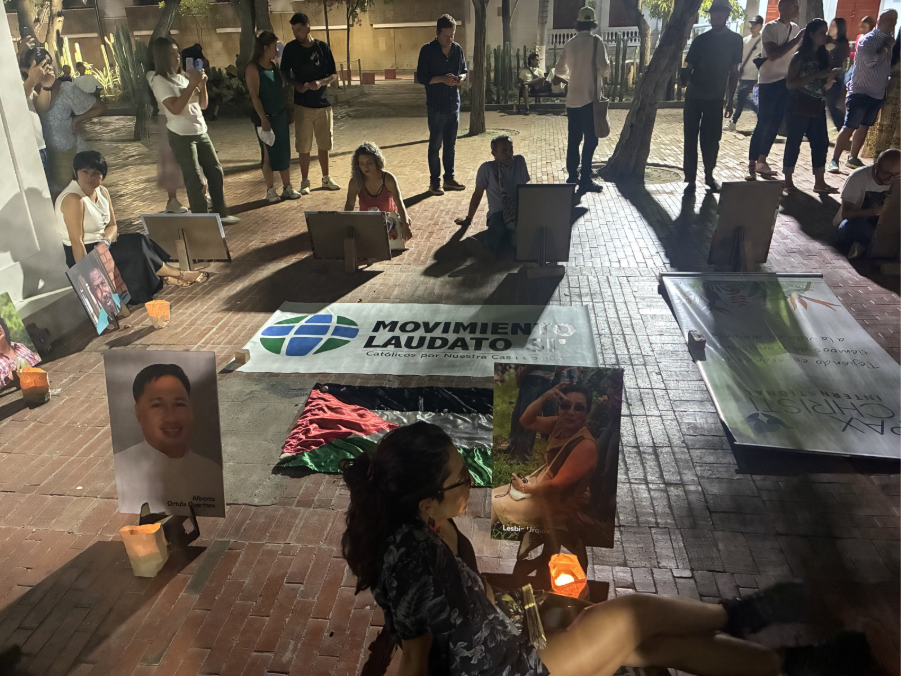
Movimento Laudato at the territory of Santa Marta.
To be cited as: Gonçalves, Verônica Korber. 2026. “TAFF Part II: The Territory of Santa Marta.” CAMAMAZON. Available at: https://camamazon.aber.ac.uk/2026/09/01/taff-part-ii-the-territory-of-santa-marta/. Accessed (xx/xx/xxxx).
This is Part II of some reflections from Santa Marta (first part). In this blog, I try to stay with and in the territory.
When I arrived in Santa Marta, the humidity was the first thing that caught my attention. It is a coastal city, and the airport itself is surrounded by the sea and beautiful beaches. Being there felt strangely familiar: the temperature, the smells – a known territory, like so many Latin American cities.
Santa Marta is a coastal city, but the beaches in the urban area are not inviting for swimming. The water is beautiful — warm and crystal clear — but the beaches are crowded, noisy, full of dogs and vendors. To reach those paradisiacal beaches surrounded by nature, you need to take a boat to Tayrona Park.
The ride downtown from the airport took around forty minutes, and going to the university or other venues required taking an Uber. Some places were walkable, others were not. I felt safe walking during the day, though less so at night. Again, it felt familiar.
One evening there was a cumbia performance at Plaza de los Novios, very close to my hotel. The plaza was beautiful: a bandstand in the middle, restaurants all around, tourists mixing with local residents.
One night, we were walking at the Plaza and I came across a small gathering organized by people connected to the Laudato Si’ movement. There were flags, candles, cards with names written on them. As we approached, we could hear a priest speaking into the microphone. They were honoring environmental defenders and activists who had lost their lives protecting territories against mining, deforestation, etc. Family members and activists read names aloud. Their words connected memories, livelihoods, spiritual attachments, political struggles. The priest said something like: may their light help us remember what they fought for and nourish our hope; may that light shine stronger than the darkness of injustice, hopelessness, and powerlessness.
That moment resonated deeply with what I had been feeling throughout the conference: a certain skepticism toward some of the discussions around TAFF, but at the same time emotion at seeing hundreds of people from different parts of the world investing time, energy, and hope in a collective project.
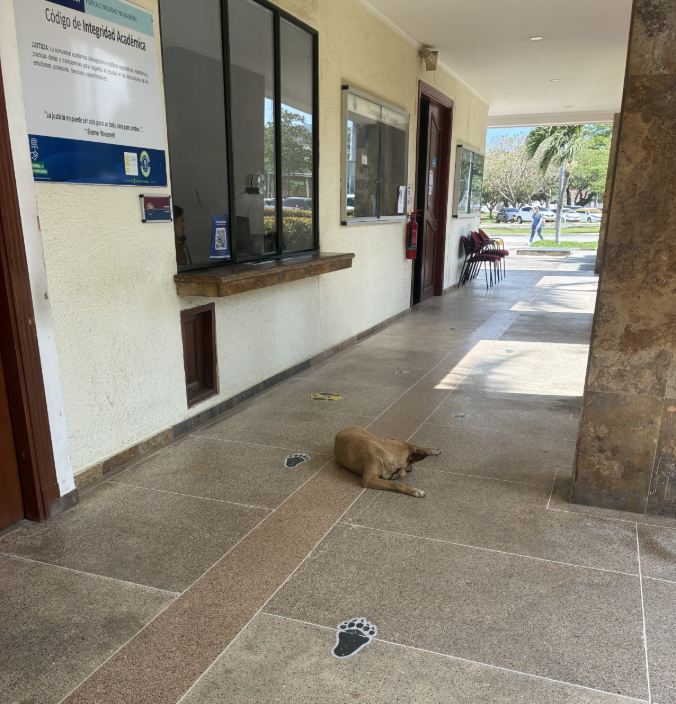
Most of the activities I attended took place at the University of Magdalena. Being there also felt confortable, familiar, in the way public universities across Latin America often do: a beautiful and walkable campus, democratic and plural, with some well-funded buildings and infrastructure, alongside precarious toilets. There were many students around, although not many seemed directly involved in the event itself.
In fact, how little presence there seemed to be from the city in the conference activities… I still struggle to understand how debates about systemic transformation can truly connect with everyday life, or how these discussions can move beyond institutional and activist circles into broader public engagement. I guess it’s me being skeptical again…
Another world is possible, one world of many worlds
I found myself wondering, at times, why I was in Santa Marta. I came to follow the event, but unlike at COPs—where I learned from Hannah that the best way not to feel lost is to follow a specific agenda item—I didn’t have one here. I had intuitions (Santa Marta–COP connections; fossil fuels and development), but no clear track. I didn’t have access to the high-level segment, and I wasn’t trying to strategically push language into a final negotiated text.
The comparison with the World Social Forum (WSF) in Porto Alegre felt inevitable. People from movements and organizations across the world gathering, coexisting, debating, negotiating fragments of a final declaration—bringing their different worlds to the table.
I learned a lot. I was reminded of the power of hope, of believing in something. I heard that Santa Marta was important for the pedagogy of movements—that transformation toward a biocentric horizon will not come from governments alone (we have to push them, not fight against them), in a radical democracy perspective, and that we need collective learning in order to disseminate it. I heard from fishers, community leaders, and others: we do not want this false development; we are the ones living the impacts; we want solutions. Demands for the recognition of the Rights of Nature, for Indigenous knowledge systems were constant. This conference is a pedagogical process.
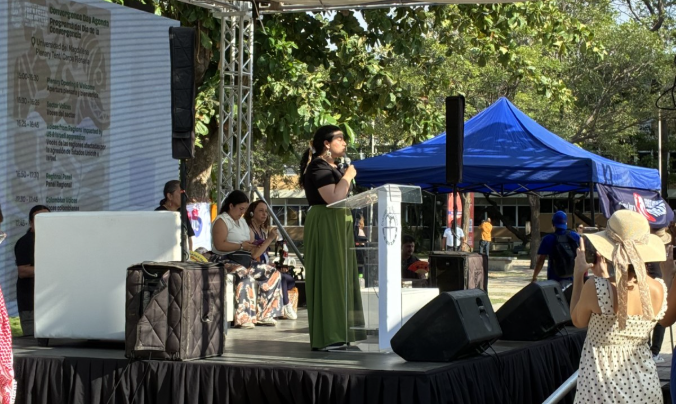
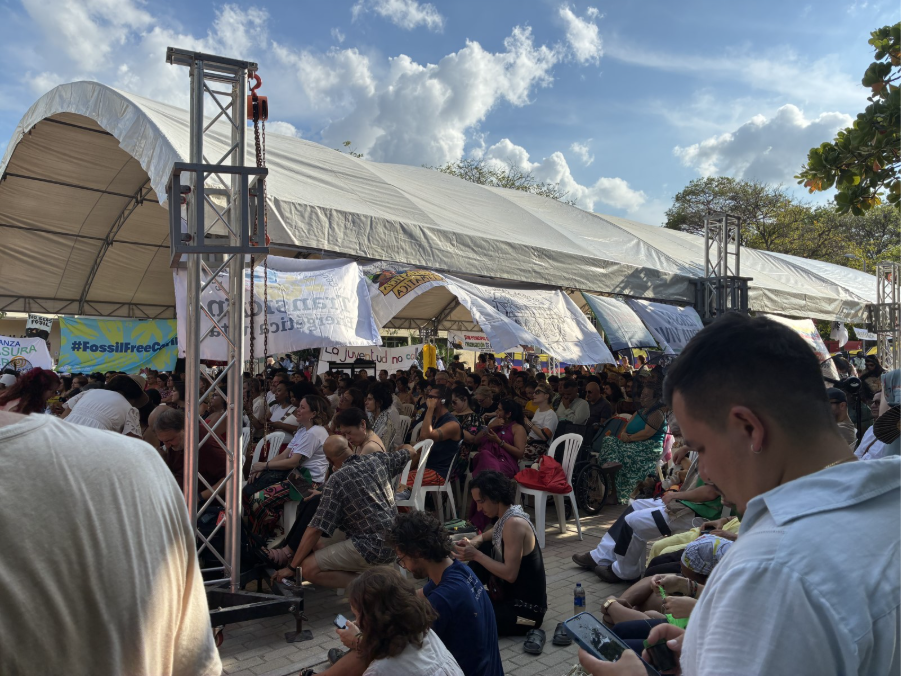
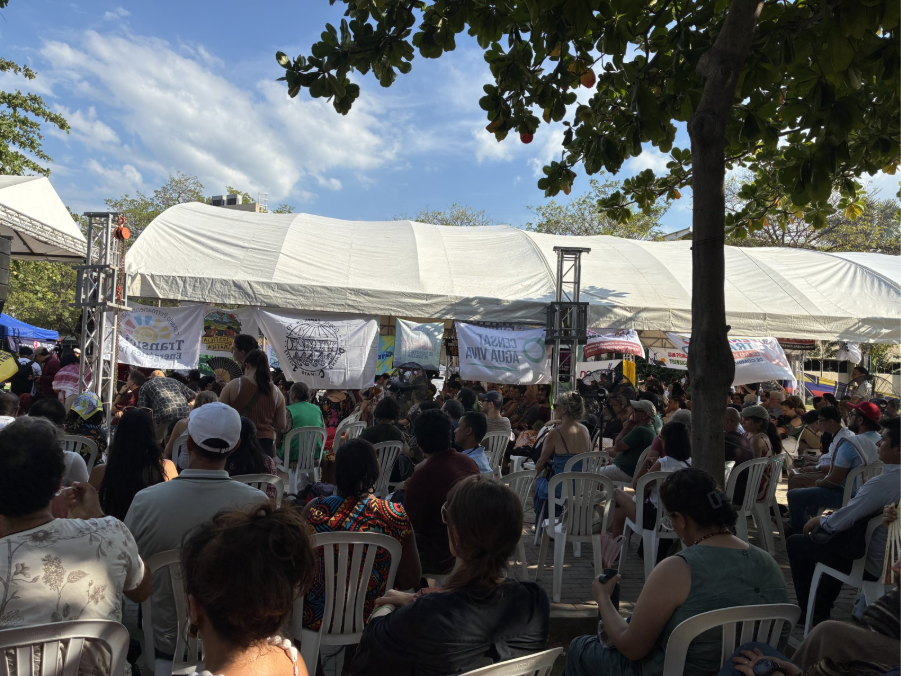
The physical setup of the TAFF was similar to the People’s Assembly at COP30 – a large tent on the grass of a university campus, heat, sun, chants, hope, people gathering around shared political imaginaries.
There was, as in the WSF or ECO-92, a strong presence of autonomist movements—what someone called an “internacional de la tierra.” A dense entanglement of territories: places where extraction is just beginning, where it is ongoing, and where it has already been dismantled. We were reminded that there is no transition without peace. And that includes wars like in Palestine or Iran, but also the Latin American context — the war against black people, the war on drugs. A call for territories of peace. A call for peace.
To move beyond technical reductionism, what remains central are the territories—and the political processes through which different worlds interact. Santa Marta is a process, not an event, I heard this more than once. And I remembered hearing the same about the COPs. Both, in different ways, are pedagogical processes for movements. But here, there was also an explicit fatigue with COP-style spaces that fail to give voice to people and communities. Santa Marta was described as a space to strengthen these voices—marked by the richness and clarity of the discussions. This persistent sense that this is a process. No immediate results. Just the need to keep insisting, keep organizing, keep fighting.
I heard about the importance of consultation protocols as tools to activate the tecido social—the social fabric fractured by extractive industries. The role of popular education and political education came up repeatedly. So did the importance of radicality—not as extremism, but as a way to expand imaginaries. Speakers at the Peoples’ Summit mentioned concrete examples of radicality, as the occupation of Cargill’s operations by the Munduruku people, in Santarém, to halt the dredging of the Tapajós River. It was an illustration of how direct action can expand what seems politically possible.
#From the territories
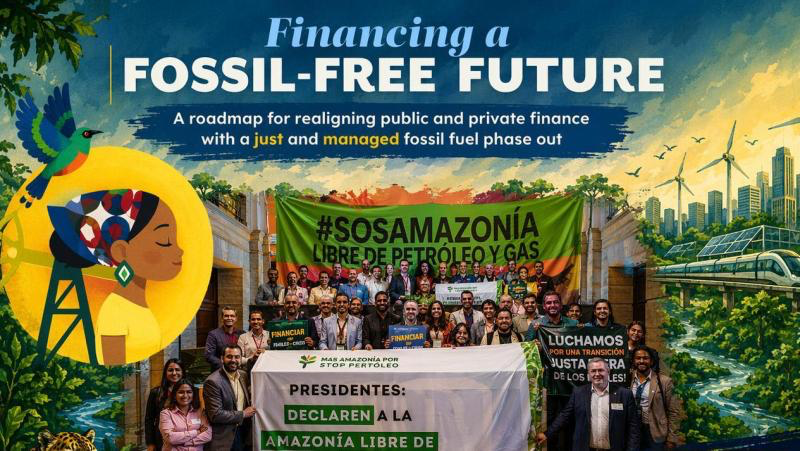
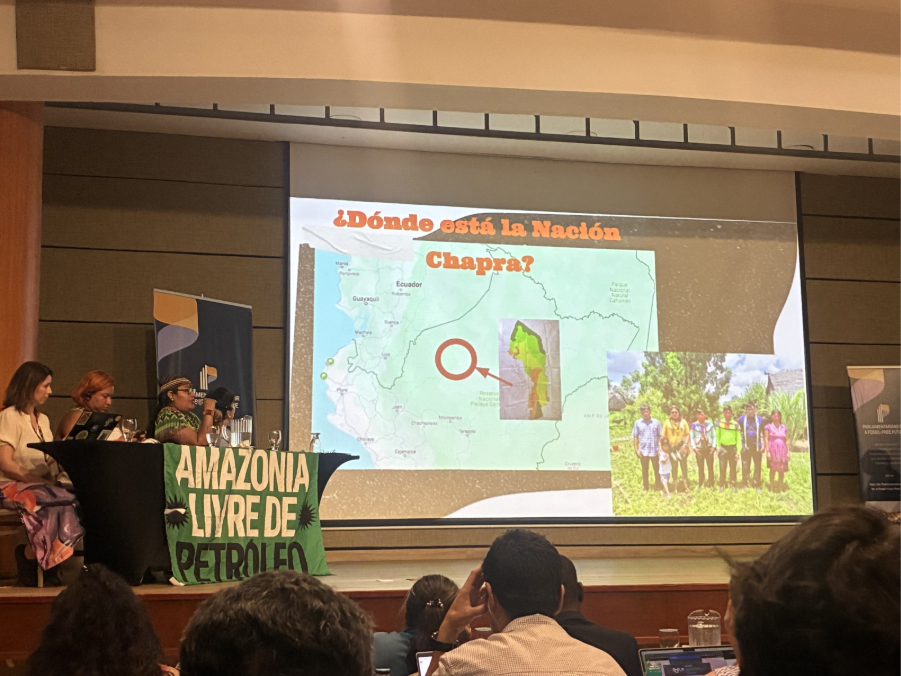
The notes below come from a single side event I followed — Financial Roadmaps towards a Just Phaseout and a Fossil-Free Amazon where Indigenous leaders from Peru and Brazil spoke about what oil and gas expansion looks like from inside their territories.
Olivia Bisa, the first woman to preside over the autonomous government of the Chapra Nation, explained that seven indigenous nations, including the Chapra, share a territory in Peru.
More than 80% of this territory is preserved, yet 95% of communities have no electricity, and none have access to potable water.
Where is the development, she asked, that is promised when extraction projects arrive?
An Indigenous woman from APOIANP—daughter of a cacique and community leader—spoke about the impacts surrounding Block 59. According to her, the company had already begun establishing itself in the region. She mentioned a report released by WWF Brasil in late 2022 concerning Petrobras and its plans to use research conducted by a French company to initiate exploration activities without prior consultation processes. Petrobras argued that there would be no impacts at this initial stage, since it involved only research activity. But, as she explained, communities were already experiencing impacts in the territory from the very beginning: rapid population growth, increased pressure on local leadership, and intensified risks in an already sensitive region marked by illegal mining and trafficking dynamics. “And if no oil is found,” she asked, “who will repair or compensate for the impacts we are already experiencing?” She also described changes that are already visible in everyday life: birds fleeing the region because of the constant movement of airplanes in areas where there had previously been almost no air traffic. “The damage already exists before we even know whether there is oil,” she said. She denounced ongoing land grabbing processes enabled by the government of Amapá, including coordinated efforts to legalize occupied lands. She also spoke about threats and intimidation directed at Indigenous leaders: “Today we are here. But we return home afraid.”
Contrasting with my experience of the COP/UNFCCC
In many ways, TAFF reminded me of being at the People’s Assembly during the COP. Even the physical setup felt similar – at least the final plenary: the large tent on the grass of a university campus, heat, sun, chants, hope, people gathering around shared political imaginaries.
Not being able to go to the High-Level meeting also reminded me of the fear of not having access to the “blue zone” at COP — although, in this case, the institutional spaces felt less attractive or central than the people’s spaces.
But these parallel events were not like the Green Zone, as there was not the same overwhelming presence of companies, partnerships, branding, and the atmosphere of private money circulating around climate governance.
At TAFF, as at COP, there seemed to be a divide between institutional discussions and movement spaces. The academic conference and high-level segments focused more on incremental change, technological innovation, governance design, and policy mechanisms. Meanwhile, the people’s events emphasized structural injustice, the limits of capitalism, and the need for deeper systemic transformation.