To be cited as: Gonçalves, Verônica Korber. 2026. “Negotiating around transitioning Away from fossil fuels” CAMAMAZON . Available at: https://camamazon.aber.ac.uk/2026/08/24/negotiating-around-transitioning-away-from-fossil-fuels/. Acessed (xx/xx/xxxx).
I was in Santa Marta from April 23 to 30, 2026, for the First Conference on Transitioning Away from Fossil Fuels, organized by the governments of Colombia and the Netherlands. I came here to learn how to even imagine a fossil-free world. This is Part I of a two-part blog, where I share field notes from that experience — some data, observations, and personal reflections — moving through themes like multilateralism, the politics of international conferences, fossil fuel phase-out, and systemic transformation. Part II will follow, on what the territory of Santa Marta felt like.
This text is based on my notes and additional notes and futher resources that I have listed below.
TAFF Conference was not a single event, but a set of parallel processes: an academic conference, the People’s Summit for a Fossil-Free Future, the “People’s Assembly,” a high-level segment with ministers and climate envoys, meetings on the non-proliferation treaty, as well as events with subnational governments, parliamentarians, and other stakeholders.
The organizers combined two approaches: something more “organic,” “autonomist,” and bottom-up…with a more structured process, which included appointing representatives from each group to produce a document per segment to be presented at the High-Level Plenary. There were tonnes of online meetings prior to Santa Marta to discuss these documents, and during the event there were many working groups and collaborative online documents. If you are part of an organization, I imagine it is easier to navigate. I often felt a bit lost. I did not come to influence the final document or contribute to drafting processes. I came to see, to listen, to learn from people who are fighting against fossil fuels.


The agenda of the TAFF, available at: https://transitionawayconference.com/agenda
Multilateralism
As the conveners explained, this event was not a negotiation process, but a summit to exchange ideas, knowledges and share (“to be honest about”, according to Vélez Torres, the Colombian Environmental Minister during the final plenary) the national challenges for the transition. The debates were structured in three thematic pillars:
1. Overcoming the economic dependence on fossil fuels
2. Transforming supply and demand
3. International cooperation and multilateralism
During the High-Levem meeting, government representatives had the opportunity to listen to civil society and academics, workers, etc. It was organized in an opening plenary (Video) with three break-out thematic sessions with informal conversation among country and civil society representatives on topics (under the Chatham House rule ) and a final plenary (video). The plenaries were invitation-only entrance, but they broadcasted on youtube (see list of resources below).
Several ministers and climate envoys delivered statements during these sessions (intermingling States and non-States actors, which was interesting to see). They emphasized the importance of transitioning away from fossil fuels not only for climate reasons, but also due to concerns about energy security and the economic vulnerability associated with dependence on such a volatile resource.
Participants mentioned, in the final plenary, their appreciation for the format. According to them, as this was not a traditional negotiation, discussions tended to be more open, with greater willingness to engage in dialogue and exchange—especially during the breakout sessions, which allowed for direct interaction between government representatives and civil society. Apparently, the process was seen as more productive than COPs more rigid formats.
According to the organizers, 57 countries attended the Santa Marta conference. Some countries (notably China and the United States) were not invited, to avoid replicating COP dynamics and potential deadlocks. Instead, the idea was to build a “coalition of the willing,” a phrase that was repeated frequently throughout the event. Participants noted that this coalition draws inspiration from the Anti-Personnel Mine Ban Treaty, which began with only a few signatories and now includes more than 160 states.
The coalition includes countries with varying levels of commitment to phasing out fossil fuels. Among the participating countries, 6 —Canada, Australia, Brazil, Mexico, Norway, and Nigeria (who said in the plenary that is interested in phasing down, not phasing out FF)—accounts for more than 80% of fossil fuel production within this set:
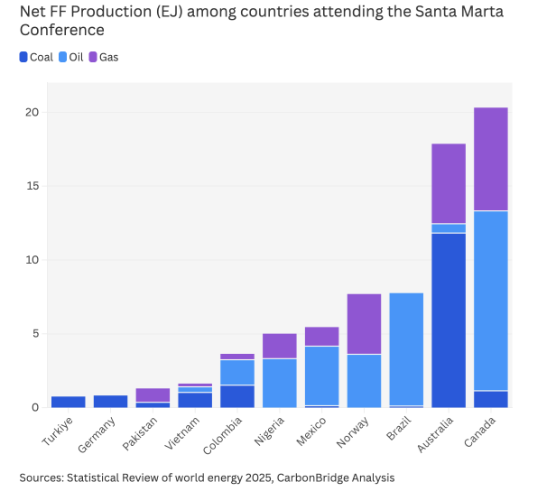
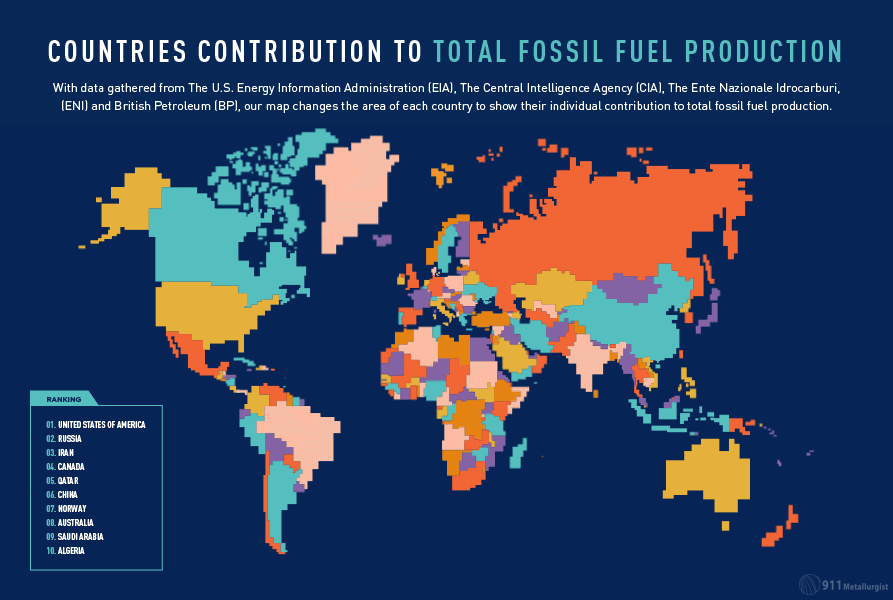
This highlights both the potential and the limitations of the initiative: it brings together some major producers, though not all of the key global actors (see below). The intention, as stated during the final plenary, is to maintain an “open coalition,” welcoming any country willing to take action.
The TAFF process predates COP30, particularly if we consider related initiatives such as the proposed Fossil Fuel Treaty. During COP30 in Belém, a group of around 80 Parties attempted to include a reference to a roadmap for transitioning away from fossil fuels in the outcome text. President Lula publicly supported this effort. The COP presidency and Brazil’s Ministry of Foreign Affairs proceeded with the proposal (although they disagree Lula’s Decision to take a stand on the topic), and it ultimately was not adopted in the final decision. The COP30 presidency is now expected to lead an effort to present a “Belém roadmap” on transitioning away from fossil fuels at COP31.
Another word I heard a lot in Santa Marta was plurilateralism. Alongside the multilateral process, and in response to frustration with COP dynamics, initiatives such as the Santa Marta conference and the Fossil Fuel Treaty are seen as parallel and mutually reinforcing, each serving distinct but complementary roles. While operating outside the formal UNFCCC negotiation framework, these processes still aim to influence COPs. The outcomes of the conference, for instance, are intended to be shared with the COP30 presidency.
In this context, Tuvalu’s Minister for Home Affairs, Maina Vakafua Talia—whose country, together with Ireland, will co-host a conference in 2027—remarked that “multilateralism and international cooperation are not defined by a single process, but rather by recognising governance gaps.”1
#The visa issue: Many civil society participants from African and Asian countries were unable to attend the conference because they could not obtain visas. This led to significant frustration, which was voiced in the dialogue channels created for the event (both email groups and WhatsApp). However, the overall assessment among major civil society organizations was that the issue should not be publicly denounced or widely amplified, in order to avoid diverting attention from the broader political struggle. At the same time, during the sessions, participants frequently expressed disappointment that barriers commonly seen at COPs—particularly in Bonn—were reproduced in a conference that had explicitly positioned itself as more inclusive.
Why do we need an international conference?
This was a question that crossed my mind several times during that week. When discussing pathways for the transition, it becomes clear that they vary according to each country’s context. Even when we talk about renewable energy, for instance, the relevance of different sources depends heavily on local conditions. So why do we need a global effort—and, potentially, an international treaty—to regulate the transition? Part of the answer, I think, lies in the Compass I helped develop last year.
1) Creating common principles
Without some form of global coordination, each country follows its own vision of a “just transition”—and these visions may conflict. International forums—such as conferences or treaties—can help to align core concepts (what does “just” mean in practice?), avoid incompatible policies (e.g. subsidies or trade), and establish a shared set of principles.
2) Addressing global interdependencies
Even if policies are designed at the national level, the transition itself is structurally global. It is shaped by interconnected value chains (critical minerals, energy, industry), international trade, financial flows, and technological exchange. Without coordination, countries may end up externalizing social and environmental costs, deepening inequalities between North and South, or engaging in forms of unfair competition—a “race to the bottom.”
3) Mobilizing finance and redistribution
A just transition requires substantial financial resources, which are very unevenly distributed. The Compass therefore points to the need to reform climate finance and to direct support toward countries with less capacity—something that can only be achieved through international cooperation.
During one of the sessions I attended, Camila Perotti (Bank Track) discussed the challenges of reforming financial systems to enable a just transition without deepening public debt in the Global South. She highlighted that private finance has played a major role in sustaining fossil fuel expansion—around USD 7.9 trillion since 2015—largely driven by banks from the Global North. This, she argued, reflects a reliance on self-regulation that has proven insufficient. According to her, what is needed is a framework to regulate private finance with clear climate rules. Existing proposals—such as the Fossil Fuel Treaty—could move in that direction, but would need to more explicitly incorporate the private finance sector. She also pointed to the scale of public finance still supporting fossil fuels: approximately USD 1.1 trillion per year in subsidies and investments in infrastructure such as roads, shipping, and aviation. While initiatives like the Clean Energy Transition Partnership have reduced some public funding for fossil fuels, significant contradictions remain. In the Amazon, for instance, 10 banks finance more of 60% of oil exploration, often through complex financial structures that obscure responsibility.
Examples from the Global South illustrate these dynamics: countries such as Bolivia have moved from production to dependence on imports, while new exploration pressures continue. In this context, discussions around regional cooperation (such as within the Amazon basin) and the notion of a North–South “ecological debt” become particularly relevant. See: More about Amazon Finance (Banks v.TheAmazon.org)
4) Ensuring that no one is left behind
The transition will have profound social impacts—on employment, fossil-dependent regions, and existing inequalities. International agreements can become tools that communities invoke in socio-environmental conflicts, shaping how justice is claimed and enforced on the ground.
5) Solving collective action problems
Conferences and treaties help coordinate commitments, create political pressure, and reduce the likelihood of collective inaction. This point was reinforced in another talk I attended by Carlos Larrea (Universidad Andina Simon Bolivar – Ecuador), who noted that current research suggests that more than two-thirds of known fossil fuel reserves must remain unexploited to ensure climate safety. This raises difficult questions about which reserves should be left underground. A significant share—around 25%—is located in megabiodiverse areas, pointing to the need for criteria such as environmental sensitivity. One proposal discussed was the creation of an international fund to compensate developing countries for preserving unexploited fossil fuel reserves. (Worth noting that Larrea was the technical director of Ecuador’s Yasuní-ITT initiative. The fund never materialized, drilling started in 2016, and it hasn’t stopped.)
Fossil fuels
#fossil fuels and elections
In his speech, Gustavo Petro posed a provocative question: “The question we must ask is whether capitalism can truly adapt to a non-fossil energy system. I will not answer it here—I leave it to you, because it must be part of a broader reflection.” He also recalled that Santa Marta itself was once a coal extraction hub, with a local economy built around mining. Those mines are now closed, and the city has largely shifted toward tourism. This trajectory places Colombia in a particularly interesting position. At the same time, government representatives and participants acknowledged existing contradictions—such as the country’s growing dependence on imported gas.
Being there, close to an election cycle, made these tensions feel even more immediate. In conversations with taxi drivers, hotel staff, and restaurant workers, I noticed that most were not aware of the conference or its agenda. People in Santa Marta were generally not following the discussions—even university students were not engaging with the activities taking place in their own classrooms. And while Gustavo Petro was delivering his speech, there were protests outside by workers from the oil industry2.
This raises a familiar concern: if energy prices rise as a result of phasing out fossil fuels, and if Petro’s candidate were to lose the election, a new government could reverse course on transition policies.3
It is difficult not to draw parallels with Brazil. We are also heading into elections this year. Luiz Inácio Lula da Silva is running for re-election, but the scenario remains uncertain. If Lula represents, on the one hand, support for a roadmap to transition away from fossil fuels—as seen in Belém—and, on the other, continued advocacy for oil exploration in the Amazon, the alternative political camp is more unambiguous: a position closer to a Trump-style approach, favoring expanded drilling and a retreat from climate negotiations.
#Away from fossil fuels??
(It is impressive how complex this process is.)
Because it is not only about fossil fuels—but also about fossil fuels. Not only about energy—but also about energy. Not only about jobs—but also about jobs, etc. It is vast and layered, and I feel this kind of framing is not helpful. It can be paralyzing: there are too many interests, too many layers, too many contexts.
What unsettled me, was that the overall emphasis seemed to be on action and implementation. As if, given the urgency of the climate crisis, there is no more time—so the focus must shift directly to responses: economic diversification, how to design better participatory approaches, better governance design to conciliate these different interests and voices.
For example, I attended a session where the guiding questions were along the lines of: how to integrate gender, race, class, and territory into just transition policies; what frameworks and indicators are needed; how to connect international cooperation with local implementation. Important issues, certainly. But the discussion felt framed primarily as a governance or management problem.
And it is not only about that. If we are talking about a world beyond fossil fuels, this cannot be reduced to a technical shift—it must be political and social, something that actively expands justice. And that is messy. It is contentious. We (who?) do not agree on the “solutions.” In grassroots movements, there are those calling for the end of imperialism and neoliberalism, rejecting so-called “false solutions”; and others defending a right to development, leaning toward a more procedural understanding of justice. Not everything is reconcilable.
(I used to be very certain in my critique of development. But then some groups argue that development itself can be reshaped, re-signified by territories—not as a linear, Eurocentric model, but as something else. Can it, though?)
This “focus on implementation” can become a trap: it reduces the political challenge to a question of institutional design. It reminds me of the debates around the BAM! – Belém Action Mechanism, which was an achievement of civil society. Now, in the phase of operationalization, there is strong pressure to avoid “politicizing” it, to frame it instead as a mechanism to improve efficiency, economic tools and governance designs.
But if we avoid politics for fear of politicizing the process, we lose an important opportunity. In Brazil and across Latin America, this tension is very present: between those who reject “false solutions” and call for ontological justice, and those who advocate for development combined with procedural justice.
An example of this trap appears in a Greenpeace policy briefing4, which states that phasing out fossil fuels globally, without leaving any country or community at a disadvantage, and with the gains of the new energy system shared by all, will demand “international cooperation, accountability, and a shared vision.” But complete alignment is unlikely! Some countries, some communities, will inevitably be at a disadvantage. Total conciliation is not possible.
But in Santa Marta these two perspectives were present: TAFF meaning decarbonization (and with that renewable, critical minerals, carbon removal, carbon credits, etc.) and transformation of the whole economic system.
#Nuclear
Nuclear energy was not a central topic and tended to be treated somewhat separately. It appeared in discussions both during the academic conference and at the People’s Summit—usually from a critical perspective—while at the high-level segment it was framed at one or two governments statements as one of the possible pathways available to states for the transition.
In the debates around the People’s Declaration for a Rapid, Equitable, and Just Transition for a Fossil-Free Future, nuclear energy was initially absent from the text. At a later stage in the drafting process, however, it was introduced as one of the so-called “false solutions.”
#Plastic
The same applies to plastic. It was occasionally mentioned as part of the transition, but there was no in-depth debate on how to transform our economies and ways of living to move beyond plastic. In this case, there were also no references to plastic in the final declaration of the People’s Summit.
Science Panel on Energy Transition
The Colombian Ministry of Environment emphasized, in her speech at the plenary, that “we need to go back to science and base our decisions on science.” In this context, a Scientific Panel on the Global Energy Transition was officially launched on the 24th at the Teatro Santa Marta. The initiative brings together scientists such as Johan Rockström, director of the Potsdam Institute for Climate Impact Research, and Carlos Nobre (USP). Both were also involved in organizing the Planetary Science Pavilion at COP30. The panel is expected to be based at the University of São Paulo and will focus on areas such as transition pathways, technological solutions, policy design and evaluation, and financial instruments and governance. The proposal is ambitious. Unlike the IPCC’s longer assessment cycles—typically structured around multi-year reports negotiated and approved by governments—the panel aims to produce annual updates and to generate knowledge that can be scaled down to the national level. It could become a very important initiative. At the same time, its effectiveness will depend on whether it can move forward.
There is clearly a need for science in processes of JT. The problem is that the approaches proposed by figures such as Carlos Nobre and Johan Rockström tend to frame the transition primarily as a technical and managerial challenge. Nobre, for example, argues that saving the Amazon depends on a new wave of “Amazon 4.0” industrialization, while Rockström’s perspective is strongly rooted in the natural sciences (and he is very enthusiastic about carbon removal).
They emphasize dialogue with private actors and stakeholders, but didn’t mention forms of knowledge beyond hard science and economics. Indigenous, local, and other situated knowledges appear marginal or instrumentalized rather than treated as equally valid ways of understanding and governing the forest.
It is also worrying to see how participation and expertise is being understood in this Panel formation. There is not much transparency regarding how experts and stakeholders are selected, who decides on their inclusion, and according to which criteria – this was not discussed for example in the academic event in Santa Marta.
Footnote, July 2026 update: The candidate backed by Petro, Iván Cepeda, was defeated in the election. The president-elect, Abelardo De La Espriella, is a right-wing politician and a supporter of Donald Trump.
Daise Dunne.”Santa Marta: Key outcomes from first summit on transitioning away from fossil fuels”. Carbon Brief, 2026. https://www.carbonbrief.org/santa-marta-key-outcomes-from-first-summit-on-transitioning-away-from-fossil-fuels/
Christopher Wright. “Six nations at Santa Marta could shape fossil fuel futures”. Climate Change News, 2026. https://www.climatechangenews.com/2026/04/29/six-nations-at-santa-marta-could-shape-fossil-fuel-futures
Sebastian Rodriguez. “Santa Marta summit kick-starts work on key steps for fossil fuel transition”. Climate Change News, 2026 https://www.climatechangenews.com/2026/04/30/santa-marta-summit-kick-starts-work-on-key-steps-for-fossil-fuel-transition
Transition Away Conference, 2026 https://transitionawayconference.com/home
Alex “Fossil fuel production by country”. Vivid Maps, 2019. https://vividmaps.com/fossil-fuel-production-by-country
Ministerio de Ambiente y Desarrollo Sostenible “Transitioning Away from Fossil Fuels (2026) ‘Plenary Session of the First Conference for the Transitioning Away from Fossil Fuels.’” YouTube, 2026. https://www.youtube.com/watch?v=8YNfFPMRXKk
Ministerio de Ambiente y Desarrollo Sostenible “Transitioning Away from Fossil Fuels (2026) ‘Plenary Session of the First Conference for the Transitioning Away from Fossil Fuels.’”YouTube, 2026. https://www.youtube.com/watch?v=suwPXFd8R8w
Jonathan Watts and Fiona Harvey. “‘Suicidal’ model of capitalism leading to war and fascism, climate summit told” The Guardiam, 2026. https://www.theguardian.com/environment/2026/apr/29/capitalism-colombia-climate-summit-gustavo-petro
References
1. Schauenberg, Tim. “Countries Set a Path beyond Fossil Fuels.” Dw.Com, 2026. https://www.dw.com/en/a-new-climate-club-minus-the-fossil-fuel-lobby/a-76992981.
2. La Solla Vacia. “Trabajadores petroleros protestan contra cumbre de Santa Marta.” La Silla Vacía, 2026. https://www.lasillavacia.com/silla-amazonia/amazonia-en-breve/trabajadores-petroleros-protestan-contra-cumbre-de-santa-marta/.
3. Christina Anagnostopoulos, Zoe Law, Christine Chen and Kay Johnson. “Colombian presidential election: Trump-endorsed De La Espriella declares win – as it happened.” Reuters, 2026. https://www.reuters.com/world/colombian-presidential-election-live-trump-endorsed-candidate-de-la-espriella-2026-06-21/.
4. Greenpeace/ Francisco Rivotti. “A Just Transition away from fossil fuels.” Greenpeace policy briefing 2026. https://www.greenpeace.org/static/planet4-international-stateless/2026/04/e4040a7b-a-just-transition-away-from-fossil-fuels.pdf.