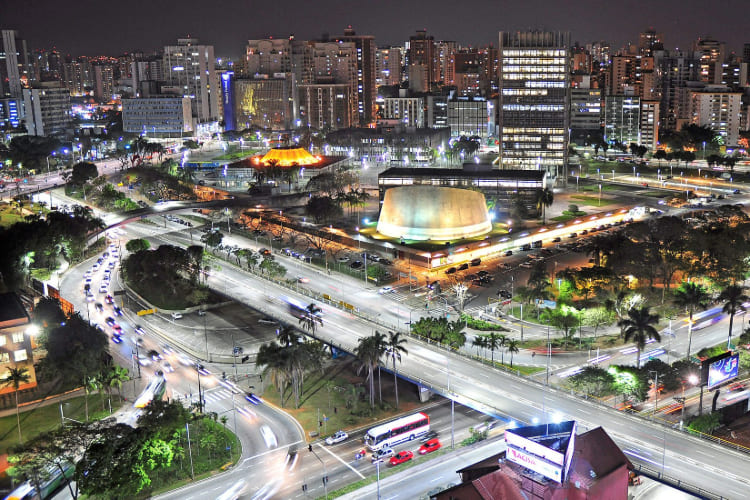
photo via Prefeitura de Santo André
This is my attempt to react to Cristina’s question about “returning to the forest” and to Hannah’s beautiful text on understanding deterritorialization through learning to reforest our minds. As I read Hannah’s reflection on childhood, I was reminded of my own.
I grew up in São Paulo — not in the capital itself, but in a city that has long since been swallowed by it — Santo André. What urban planners call conurbation — the merging of cities into one continuous urban mass — shaped my childhood landscape. It is a region profoundly urbanized: very few trees, very little green space, endless concrete, high-rise buildings, asphalt, noise, pollution.
As soon as I could, I left (I return often to visit those who remained). And I do not feel a deep sense of belonging to that territory. I carry memories of people and places, yes. I remember vividly feeling sad as a child, thinking it was ugly to live in a city that appeared grey and polluted to my eyes — so different from the bright landscapes I saw in cartoons. It was not possible to swim in the Tamanduateí River.
Later, I understood that my comparison came from the places where I spent holidays, vacations — spaces where green and water were still present. When I try to access or understand what “territory” means to me, I go to the Serra do Mar and to the sea. I guess the deepest sense of connection emerges when I am in the Mata Atlântica, facing the Atlantic Ocean. But what I feel there is not exactly belonging. It is wonder. Gratitude. Connection between land–people–smells–time–ocean. (Is this a form of cheating, considering that I am not from there, I do not live there, and I cannot anticipate a change in the weather by the way the wind moves through the trees?)
Sometimes, when I go back to Santo André, I try to look for what Anna Tsing might call “mushrooms in the ruins” — forms of life that persist despite capitalism (Tsing 2015). I look for the fragments of the Mata Atlântica surviving along polluted riverbanks. The small backyard that has not yet become another condominium tower. The weeds breaking through cement. It is often a melancholic exercise, almost one of resignation. And yet, my experience of disconnection is not universal within that space. I know there are people that coexist with nature there — many times as material necessity, as daily practice shaped by inequality. People who survive within precarity. People who build relationships with the land ‘in the ruins of capitalism’.
My inability to feel rooted does not mean that other ontologies are not alive in the same territory. What remains for me is to recognize that. Recognizing that multiple ontologies coexist. Worlds I can respect and value, but not fully enter. Maybe re-foresting is about learning to perceive the forest that persists — in fragments, in ruins, in margins? Is witnessing, too, a form of care?
References
Tsing, Anna Lowenhaupt. 2015. The Mushroom at the End of the World on the Possibility of Life in Capitalist Ruins. Princeton: University Press.