To be cited as: Valencia-Duarte, Diana. 2026. “An attempt to sentipensar COP30 from a distance”. Available at: https://camamazon.aber.ac.uk/2026/03/19/an-attempt-to-sentipensar-cop30-from-a-distance/ (Acesses xx/xx/xxxx)
It has been four months since the COP30 in Brazil.
While my wonderful colleagues, Hannah, Marcela, Veronica and Cristina were there in Belém, observing the event as part of the CAMAMAZON research team, I remained in Aberystwyth with my classes. Coincidentally, I was conducting my module on the Environmental History of Latin America at the time. One of my classes dealt with the history of the Amazon, and Belém was part of it; so, Belém was in my heart. And so were my colleagues and the communities who had been preparing for months for the COP and had so many hopes around it.
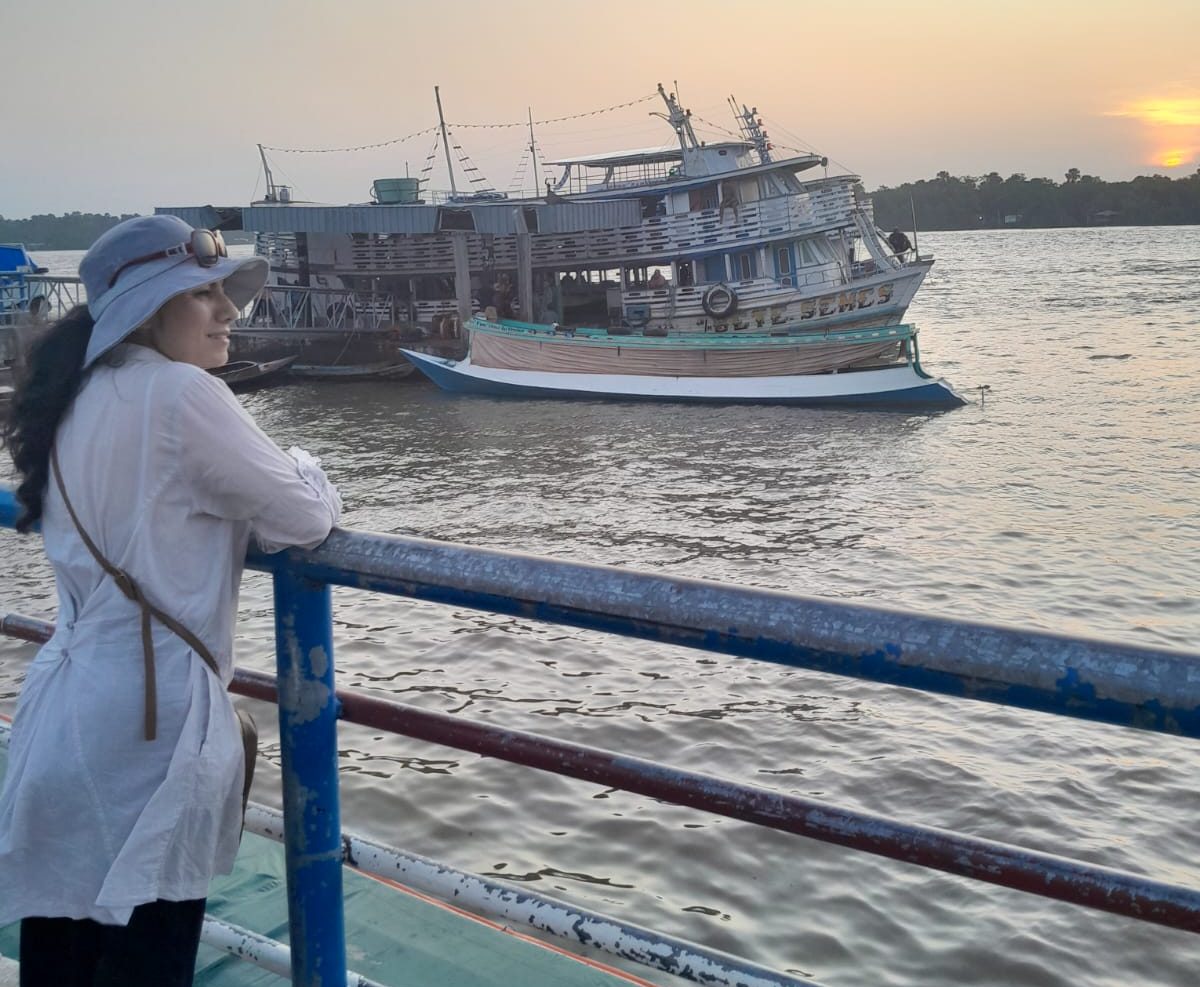
I knew some of these communities since I was part of the 2024 CAMAMAZON workshop, a week full of powerful, happy and sad stories and learnings. With the people of Belém, we shared food and hugs and “fraternidade”. We were “um povo latino”. The communities of Belém I met reminded me of the Colombian “amphibious people”, fishermen and their families who live with the water. These were, in my “imaginary”, the people receiving VIP delegates from all over the world to talk about climate at the 2025 COP. Therefore, I kept a close eye on the news and initial reports were not promising, although word of Indigenous activism was encouraging. Later, I could contrast these reports with my colleagues’ insights, which I am still processing in the only way I can, given my connection with my own “territorios”: sentipensando.
In this text, I am aiming to disentangle, or perhaps, rather to entangle ideas of sentipensamiento, multi-territoriality, and tierra – and Tierra. To give a sense of the positionality from which I read and learn from experiences brought to me by my colleagues and other CAMAMAZON project members from COP30.
To sentipensar my colleagues’ experiences at the COP, from the outside, is very complex. For me, it is difficult to place myself in spaces of world governance – in those powerful chairs where decisions are made affecting us all, all while the rest of us, including those Belém communities, wait behind the door. The hypothetical me – if I had been there – would probably have joined Cristina and the protesters outside, the Indigenous people trying to enter, or the young people in their alternative spaces. I would have looked for the Movimento dos Trabalhadores Rurais Sem Terra MST (Landless Workers Movement) because my scholar-activism has always been placed with the peasants, the “peoples of the land”.
It is not possible for me to think of spaces like the COP without sentipensar – without being filled with many very overwhelmingly strong emotions. This is why it feels easier for me to start this reflection from there, from the sentipensante approach and my way of understanding what could be my – or rather our – multi-territoriality. Strong reactions emerge when I feel that we need to defend our beloved Tierra from the, as well as, at the COP. Particularly when said convention should be, in fact, its main line of defence. Thus, thinking also becomes emotional and, inexorably, sentipensante.
When the peasants of the Colombian Caribbean coast explained to Orlando Fals Borda, in the 1970s, what it means to be sentipensante, they did so from their context of amphibious culture. That is, from a perspective that is already multiterritorial, men and women with deep knowledge that “combines the aquatic with the Earth”(1). It was in a village called San Martín de Loba that, according to Fals, a fisherman told him, “we really believe that we act with the heart, but we also use our head, and when we combine the two things, we are sentipensantes”.
A second way of understanding the amphibious culture’s sentipensamiento is from the spiritual self-identification of amphibious peoples with the idea of the “hicotea-man”. This is an affinity with the little Colombian turtle that buries itself in the summer and comes out happy again when the rains begin. The fishermen of the San Jorge river put it this way: “we are hicotea-men, we suffer a lot, but we also enjoy, and when we do the sum, in spite of our poverty, joy wins”.
In other words, the sentipensante person, or collective, has three overlapping “motley” skills: they can think with the heart and the brain, they live and thrive in multiple-territories, such as the water and the land, and they might suffer immensely and still celebrate life like the hicotea.
There in the streets of Belém, outside the COP30 venue, there were many men and women of deep connection to the forest who stuck their heads out and shouted loudly. True hicotea-people. They did it for all of us, in the midst of an environment that, despite being designed to be inclusive, was still hostile. Worst of all, that remains hostile to the change so needed to save the systems that sustain life itself on this beautiful planet, the Earth, la Tierra.
This leads me to the concept of “tierra”, which is precious to me, and therefore, a key element of my sentipensamiento. The beloved “mi tierrita” (my little land), is our land, my “territorio” and your territory and the soil that sustains our plants and the flowers in our gardens. Tierra, is that same “terra” in the MST “trabalhadores sem terra”. To sentipensar la tierra in English, I am aiming to convey the power behind la lucha por la Tierra (fight for the Earth) and la lucha por la tierra (fight for the land, as the traditional peasant and/or Indigenous struggle) as one unique multi-territorial call occurring at several levels.
I recently discovered how much I love the word “tierra”. I found myself listening again with great emotion to the powerful Boccelli’s Canto della Terra. I never get tired of it, although I always cry. Tierra (with capitol T) is also the name of our planet in Spanish (Terra in Italian and Portuguese), the Earth; but it is still also the land, the territory, our piece of living soil, and that garden soil that goes into our fingernails when we played with the mud as children, “jugando con tierrita” (playing with the mud). Picture this: all that – mud, land, Earth – is one and the same wonderful word, Tierra, Terra. Touching it, smelling it, is an experience that fills the senses. Each and every handful of compost you use to cover seeds is part of a big living organism called Tierra. It is also us, we are the Earth. No other known planet comes close to its extraordinary development: life. That is why listening to the Canto della Terra brings tears to my eyes and brings me back to the COP. La Tierra Earth we are trying to save, and mi tierra is one and the same entity. Many times, even if I try to understand the solution-inhibitor logic of those international negotiations, I do not get them. Perhaps it is because the negotiators are not sentipensantes, they are only capitalopensantes. Maybe.
If I had to think my relationality with la tierra in terms of an animal, it could not be the hicotea as in the case of the fishermen of San Jorge, I am no amphibious woman. I am more likely to look up to the birds taking care of their nests in spring and to the squirrels preparing for winter. I can certainly relate, since, like them, I tend to seek safe places. This is why I also navigate multiple territories: The place I call home, the home that I left, or the University where I am the person I hope to be.
Wherever I am, however, I try to fracture the system from the complex multi-territorial place I “inhabit”. I do this every day, for example, by finding or developing methodologies that help my students to be critical and sentipensantes themselves: to think with their hearts, navigate multiple worlds and enjoy life even in desperate times. Perhaps they will be capable of achieving what our generation has not been able to.
What I experience when listening to the Canto della Terra might be forms of “rage” and deep sadness. We have learned from sisters and brothers Zapatistas that anger could be dignified and used creatively (2). In spite of those complex sentiments, as a Colombian, it is not strange to me to find joy and hope. Although in this case, hope found me, to be honest. The “call of life” adjacent to or scratching the climate coloniality of the COP emerges from the reflections written by my colleagues and the young people who accompany this project. I read their reflections carefully to provide Spanish versions of the material that, more than simple translations or interpretations, can be faithful to the original message. They give an account of many efforts, learnings and even small and medium (perhaps also big?) grassroots victories that are very significant in the context of this COP. It comforts me to read the CAMAMAZON blog. A lot. There are many people and groups who are gaining ground at the COP, who are expanding their territory in terms of possibilities for action.
The more I reflect on the COP, from those places of sentipensamiento multi-territorial and personal connection with la tierra, the more I tend to conclude that the COP tier system might be broken. Although I recognise that the space still accounts for victories for the COP dos povos, the peoples, I still perceive the impenetrable core as inefficient and almost stuck. A hierarchical organisation keeping Indigenous local communities outside the decision-making table which is fundamentally colonial. And, on a more global level, as loud as all our voices might be, peoples of the world remain unheard. My hope is that we can collectively bring down some walls that we take for granted here. After thirty years of climate change agreements, being invited into these incredibly slow conversations might not even have the impact we expect. Perhaps we need to change the whole table. Perhaps from our multi-territorial realities, for la tierra, we must sentipensar the best path towards the effective decolonisation of climate resolutions.
This blog is part of a conversation between CAMAMAZON project members on our relationship to the territories of a multi-territorial ethnography. For more in the series, see: Territories.
References
1. Orlando Fals Borda – Concepto de Sentipensante [Internet]. 2017 [cited 2025 Sep 23]. Available from: https://www.youtube.com/watch?v=mGAy6Pw4qAw
2. Quintana L. Digna Rabia. Rewriting peace and conflict [Internet]. 2025 Dec 16 [cited 2026 Feb 23]. Available from: https://rewritingpeaceandconflict.net/2025/12/16/digna-rabia/