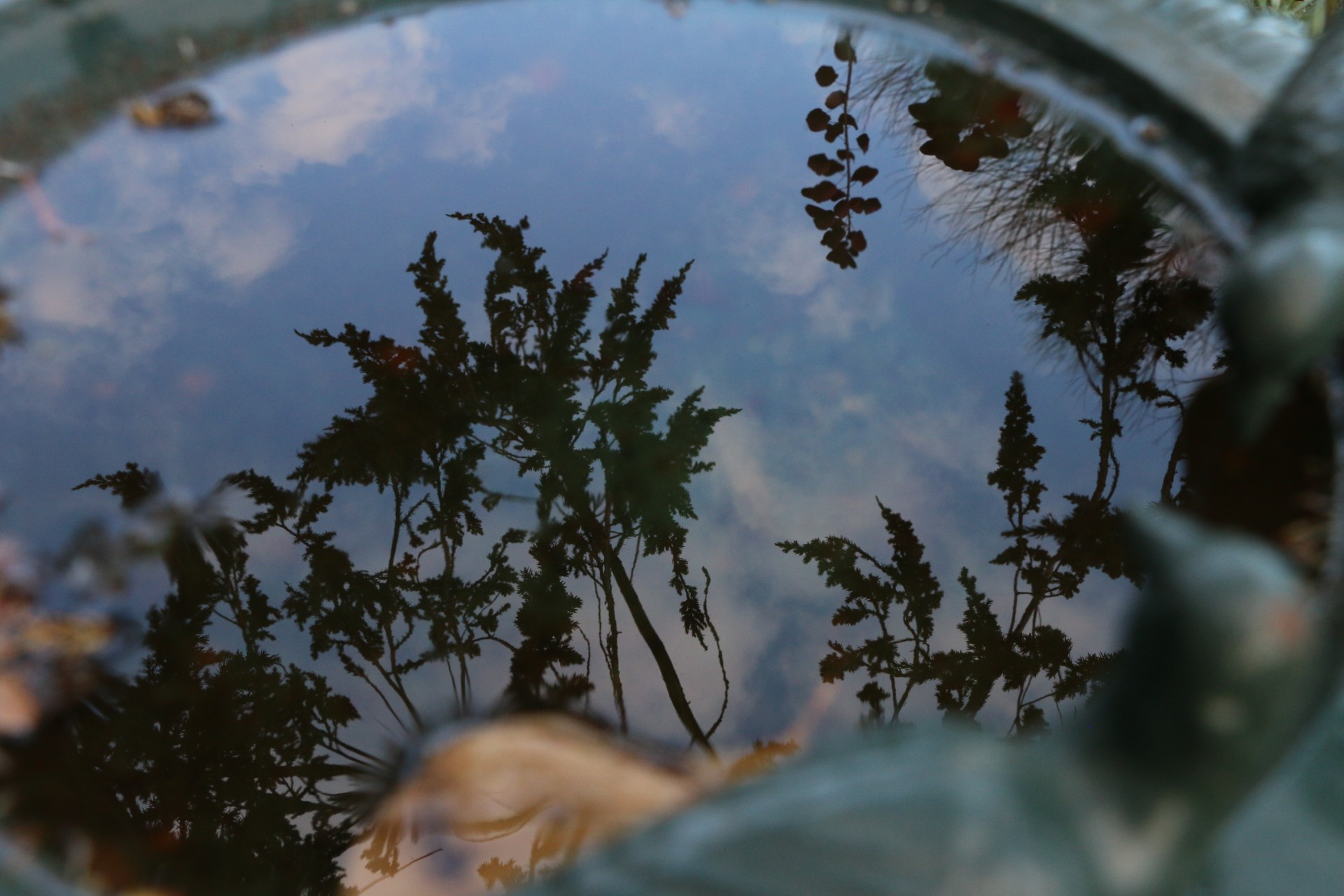
Photo taken by Erzsébet in 2017.
To be cited as: Strausz, Erzebet. 2026. “Travelling across territories”. CAMAMAZON. Available at: https://camamazon.aber.ac.uk/2026/04/27/travelling-across-territories/ (Accessed: XX/XX/XXXX).
I remember the hot summers I spent as a child playing in the fields near my grandmother’s house. With the other kids from the street, we roamed around the gardens we knew, but we also ventured beyond, to the dust roads and the tree islands scattered across neglected agricultural land. Our playground appeared wherever we stopped, at the unruly edges of a small town in rural Hungary. Building things from sticks and mud whenever it rained was our main activity. We re-created objects and spaces that we had known from our homes in the middle of a wheat field, in the bushes, on the branches of sour cherry trees. Moving between worlds – the density of overflowing, untamed vegetation and the predictability of the built environment – happened with such ease that we had never paused to think about it. This way of being simply was.
It is only many decades later that this experience takes on special significance as I travel with my colleagues’ ethnographic journeys to and through the COP from a geographical distance.
Listening to their experiences of navigating various infrastructures of disconnection at this mega‑event, I found myself attuning more and more to those felt, genuine moments of solidarity and togetherness, and to insights beyond familiar discourses. These revealed a subtle yet deeply felt and alive register to inhabiting these material and epistemic frames. I noticed that the distance of my witnessing was, indeed, only physical. In my mind – even if I might not have been able to imagine the specific details attached to place and people – the crafting of relations to the COP as a ‘territory’ felt so resonant and relatable.
As Hannah notes in another blog entry, our diverse spatial situatedness as members of the project team also carries important epistemological significance:
‘From the outside at least, it looks like none of us embody a single territory as home. We have each moved and been moved from place to place, and from that respect, it could be said, that we each embody multi-territorial relations and are shaped, in varying ways and degrees, by a dominant world.’
Her observation that ‘there is a shared relationship of travelling across territories’ echoes strongly in my mind. We all carry imprints of territory within ourselves – a connection to soil, plants, and whole ecosystems – even if, as Verônica notes in her post, we might not feel particularly rooted in the places of our upbringing.
Movement across territories requires constant negotiation of both connection and disconnection. In my own efforts to cultivate ways of being and being together that doesn’t hold stark separations – in the classroom, in my writing and research and how I world everyday life, within myself and together with others – I keep coming back to the question of how to hold disparate, perhaps even conflicting, planes of experiences, and find ways to make them accessible from and to each other. Multi-territoriality, for me, translates into the relations that I carry from and to those life worlds that have shaped my own personal history. I imagine it as a fluid constellation of moving affective landscapes (Strausz 2026).
My educational trajectory took me away from the fields, transporting me to the city and predominantly urban landscapes. In the process, it also distanced me from the experience of what Maria Lugones describes as ‘world‑travelling’ – the ease of movement across multiple worlds with creativity and playfulness (1987: 16). The more immersed I became in the world of Western social science and academic research, the less I was able to connect with other ways of knowing and being in the world.
Lugones contrasts ‘loving perception’ – an empathetic gaze of openness to other worlds and otherness within – with the arrogance of the Western ‘agonistic traveller’ (1987: 5, 15) who only plays to win and conquer. The competitive player worries about competence and self-importance, seeks to fix meaning and identity while feeling frustrated by ambiguity. The world-traveller improvises in their ‘openness to being a fool’ and finds delight in what may lie beyond established norms. Their playful attitude ‘turns the activity into play’ (1987: 15).
Investing years into becoming fluent in the language of a hegemonic and competitive academic world – as an attempt to regain the ease of movement – only resulted in limited mobility. Even when with practice, concepts opened up and discourse started to bend to my intentions, becoming less of a mystery, learning to play the game in a more skillful way felt like no real play at all. Free roaming across diverse terrains turned into what felt like shuffling around in small circles. Worlds no longer connected even if words were more carefully chosen and acquired better grammar. It felt like a split – the performance of the seriousness of expertise and everything else around it that didn’t claim such high ground yet have been vital for sustaining life. Conversations, walks, meals, trees, blue skies, gestures of care, spontaneous moments of joy and kindness.
Regaining movement across the territories I carry within – and, with that, access to other ways of knowing and being – required a sustained, untrained kind of effort. Echoing Veronica’s powerful questions: ‘Maybe re-foresting is about learning to perceive the forest that persists – in fragments, in ruins, in margins? Is witnessing, too, a form of care?’ For me, it first called for noticing and staying with the disconnect – for holding the rupture. From there, I began to learn how to attune slowly to other, more life-affirming possibilities of sense‑making. This learning – which also necessitated the unlearning of an extractive mindset be that information, insight or what might appear as raw material for interpretation – is still ongoing. I am working to reconfigure monuments made of abstractions and disconnected sensibilities into mobile assemblages – closer to those made of sticks and mud.
This blog is part of a conversation between CAMAMAZON project members on our relationship to the territories of a multi-territorial ethnography. For more in the series, see: Territories.
References
Lugones M. Playfulness, “World”-Travelling, and Loving Perception. Hypatia. 1987;2(2):3-19.
Strausz, E. Curating Learning Journeys: Transformational Experiences in the IR Classroom and Beyond. Palgrave Macmillan. 2026. (Open access – link to pdf)