One of the conversations that we have been having in our CAMAMAZON project team, is can we think the COP as territory, and what does thinking these mega-events as multiple territories do to how we observe, understand and analyse the politics of climate negotiations? This approach was inspired by Marcela‘s research with Indigenous Peoples. Her work illuminates the political mobility of Indigenous politics as enacted through Indigenous climate diplomacy (Vecchione-Gonçalves 2009; 2014; Beier 2009). In the struggle to defend and protect territory and territorial lifeways, Indigenous diplomacy is mobilised and taken to where threats originate and where defence can be made. As Marcela writes, “this is a way of making place – as a political and social territory – through places, in the sense of building affective connections as related to one’s group’s own cosmology” (Vecchione-Gonçalves with Hughes 2023, 75).
As a collective of researchers, this has attuned us to the territorialisation of diplomatic practice and also the potential transposition of one territory on another through the COP event itself and its negotiated products. This means that at the same time that a territorial approach sensitises the researcher to the place specific and yet mobile character of Indigenous diplomacy – carrying territorial relations to the international space of the COP to struggle for the continuation of the territory; it also alerts us to the fact that it is the dominant territorialised diplomatic practice and products of the COP that perpetuates the erasure of diverse land-people relations in the first place.
To prepare ourselves for our ethnographic experience of COP30, and to help facilitate the development of a shared attuning of our thought and research practice to a territorial approach, we held a series of “reading” meetings. One of the chapters that we engaged with was Kimberly Marion Suiseeya and Laura Zanotti’s (2023) account of ethnography, which is developed from collaborative event ethnography undertaken at the same venue in Belém. As Marion Suiseeya and Zanotti highlight in the chapter, research tends to “prioritize verbal expressions (in the form of talks/speeches” rather than attuning to the multi-sensorial and “semiotic landscapes of mega-events” (2023, 199). This challenged us to look beyond the negotiating agenda to the temporary constructed landscape of the COP, as situated within a territory of the Amazon, and as descended on and traversed by thousands of territorialised and de-territorialised participants from around the world. Erzsébet, who has become the project’s facilitator of reflective writing practice, encouraged us to find spaces during the COP to sit down and record the textures of the spaces we traverse (Strausz 2026). This blog is a first attempt to write up some of the conversations and reflections between Hannah, Cristina and Verônica as stimulated by this collective approach to study.
Hannah: Is this territory any different?
One of the things that struck me most walking through the venue was how much this felt like other COP venues. As soon as I entered, the space and its navigation were familiar to me from previous COP experiences: queuing and passing through security, collecting my badge, being scanned into the conference itself. The same carpet, corridors, CCTV screens and water coolers. I put this to Verônica, but she points out that all she can see is Brazil.
After our conversation I look again. It is true that there are more staples visible than usual. We wonder together whether the temporary toilets really will last two weeks. By day two many of the doors have lost their handles and it’s hard to find one that closes and locks. Because World Toilet Day takes place during the COP, there are stickers on the doors. As I stretch to hold the door closed, they remind me how many millions of children in this world live without a safe toilet.

After a few days the toilets are brought into the politics of Brazil’s choice to host COP30 in the Amazon city of Belém. Governments’ concerns over the host city and the cost and standard of accommodation were raised at the intersessional in Bonn in June 2025. Over the summer, pressure to move the event to a larger Brazilian city mounted, with the UNFCCC Secretariat advising that the leader’s summit could be hosted elsewhere to relieve accommodation pressure. The presidency holds firm – the event will be in Belém.
On Tuesday the 11th of November, the second day of the COP, security is breached at the venue by Indigenous protests over access. In an official letter, the UNFCCC Executive Secretary, Simon Stiell, outlines the host’s security responsibilities and also raises the issue of the toilets. The letter indicated that there were “multiple complaints regarding the condition of toilet facilities, including broken doors and fixtures,” and stated that toilet closures had caused “considerable discomfort and reputational concern for delegations and participants.” Heat within the venue was also flagged as an issue, with assurance requested from the COP hosts that temperatures would “be brought down within the next 24 hours.”
Lost in the politics over the venue is the true stakes of these meetings and for me at least, the very purpose of agreement-making in all its forms: making shared worlds habitable – perhaps even thriving. If only an agreement could have been reached within 24 hours that would bring down the global temperatures driving extreme weather events that are pushing the poorest and most vulnerable within every society to the edge of survival. This struggle over the conditions within and outside the venue also illuminate the COP as a territory and the transposition of one set of territorial values onto another; as if there is only one standard of acceptable conditions for some that overshadow the need to realise livable conditions for all.
The struggle over security at the venue also reveals how the COP territory is carefully closed off from and to the territories in which it is situated within, and the frustration and desperation this creates when it is the decision-making within the venue that can determine the viability of all territories.
Belém, as a host city, brought the COP into close proximity with real life and the lived reality of global warming, despite all the efforts to keep the negotiations in the blue zone cordoned off, and to ensure that life on the periphery – its extreme heat, poor sanitation, voicelessness – didn’t intrude in any of its forms in formal proceedings. The rain pounded down and trickled through the venue; proceedings paused and then carried on. Verônica was right, it was difficult to maintain the territory quite as it ought to have been when hosted in the Brazilian Amazon.
Cristina: The many COPs and territories in the city of Belém
For me, COP30 happened differently in different spaces in Belém. I moved around the blue zone, green zone, the houses, Federal University of Pará (UFPA), Museu Goeld and literally marched with the People’s March. There were sharp contrasts even within the blue zone: the negotiation spaces, the pavilions and side-event rooms. Though, in general, there was the sense of impermanence, the area where negotiations happened was much quieter, air-conditioned (cooler). But I could feel the tension in the air, how people rushed from one place to another, half-smiles and frowns. Exhibits, panels, seminars happened in the pavilions, where there was much more noise, the air-conditioning was not working as well, different visual stimuli, some mess, people lining up to get a free cup of coffee or collect souvenirs, and speakers competing for attention, like myself when participating in two panels.
In the pavilions, I did not feel tension, I still could see people rushing but they were more relaxed. It was more chaotic but many interesting and different things were happening all at once. For example, on the second day (11/11/2025) I was wandering around the pavilions and ended up in the “Planetary Science” booth. It was the launch of the “Amazon Assessment Report 2025. Connectivity of the Amazon for a living planet”. Each chapter was presented and discussed by one of the authors. My attention was caught immediately when I heard the words “territory, territoriality and living-well”. One of the authors highlighted the importance of these notions to build bridges among knowledges, and the solutions that come from the territory. They recognized that these “solutions” are ways of knowing, so that chapter was not a review of the literature but a validation of knowledge where it is produced. The word “territory” was repeated many times during the presentation. Another point was the need to distinguish afro-descendant peoples within the broad category of local communities as a demand from afro-descendant peoples themselves to face invisibility. Thus, the words that I wanted to hear: Amazonia, territories, peoples, living-well were found elsewhere, not in the negotiation spaces. This realization served as an inspiration that guided me through COP 30: I would have to circulate among diverse spaces (see map).
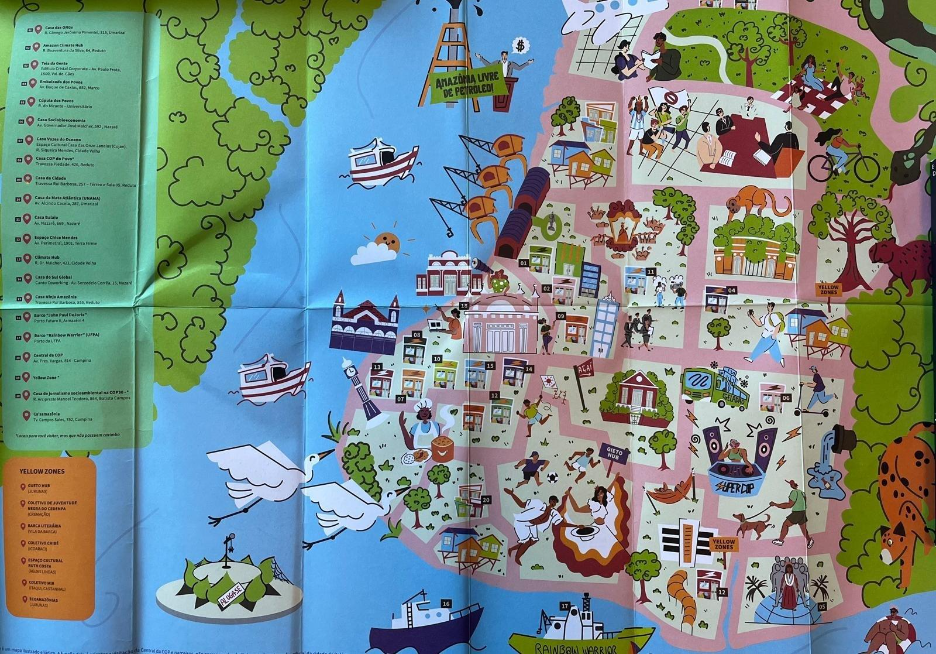
As seen in the map, COP 30 allowed me to circulate around Belém beyond the venue, and observe diverse spaces: the “houses” (Casa do Sul Global-Global South House, Casa Balaio), Goeld Museum, the Peoples Summit, the People’s March, the Agri-zone (Embrapa), the Aldeia. I also circulated a lot within the blue zone, between negotiation rooms, press releases, side-events and events at the pavilions and the green zone. Looking at the map, I also realized where I did not go: the free zone, the yellow zone or what I did not see much: the river, the barcarata… and the forest, which I only experienced as a fragment while at Embrapa or as samples of forests at the Goeld Museum.
And it was there, at the Goeld Museum, that I heard the most inspiring words, Davi Kopenawa’s, at the “Planetary Embassy” (Imagining Planetary Diplomacy, 13, Nov 2025). Firstly, fortune helped me there. I had not registered but was miraculously allowed in (the system was offline). It was crowded and I had to stand for more than 2 hours with little space to move, but his words and the whole atmosphere, the trees’ humidity, the birds, just kept me there, as if I was under an enchantment. Firstly, how Kopenawa identified himself: “I am a forest’s child, Omama’s child”. For the Yanomami, Omama is the one who created the forest and protects (guards and defends) it (see Kopenawa 2023). “We live there in the forest. We all live in the same world, a big land”. Kopenawa also highlighted that we (“white people”) are the main threats to the forest. Here, I think he was referring to the ways of being and knowing in the cities, as he also mentioned that it is hard to “return to the forest” because of the city lights and all that urban life entails. “You are afraid to return to darkness”. People in the cities are addicted to fossil-fuels and city lights. That statement made me think why it is so hard to transition, or to find pathways for “transformative change for sustainability” and to question myself, the way I have educated my son and more than that, is it really possible to “return to the forest”? As we have been writing about (foresting in Inoue et al. 2025), what does it mean to return to the forest?
Verônica: The questions I am left with
I started writing these notes at Belem’s airport, after 13 days of being there. Rain was falling as I made my way to the airport. It makes everything greener, more humid, hotter. I feel connected to the place. My head spins as I try to make sense of my thoughts — the world does not need another summary, another list of bullet points of what was agreed, expectations versus achievements. But I have questions.
About COP
Is it worth holding these megaevents – so expensive, delivering so much less than what they could? Not only in terms of major political deals, but even in basic procedural efficiency. How is it that we still have decisions by consensus at COPs? Does multilateralism have a chance in 2025 when it comes to climate change? Do we still have a chance against climate change?
How can we – as a world – have a chance if not everyone has the same rush?
What role does the idea of development play inside the negotiation rooms? Is it the concept that shapes the imaginary of every “non sufficiently developed” part of the world? What does development even mean? (I may not know, but in the rooms the negotiators seem to know very well – and they know it is intrinsically linked to fossil fuels).

I usually think COP as a process, an event embedded in an international order. But the issues debated there go beyond procedure and process. Some of them question that very order; they create tension around the need to change it. There is a claim for a fairer, less unequal world. And yet, it still feels like the same dominant world. China, Saudi Arabia, Brazil — is the so-called Global South perspective just another version of a conservative-developmentalist-One World world order?
About Brazil
As Presidency, were we arrogant? Did we think we could achieve more than what was realistically possible? Was Mutirão more than it seemed? (It seems it was hot air). Why was Saudi Arabia so comfortable in the room? Considering the European Union and China’s positions, did we really have any chance of a different outcome?
The Presidency talked so much about participation – yet doors were closed during the second week. Why? Was it a trade-off – to reach any consensus, did they have to sacrifice open doors? If the result of the tradeoff was the Mutirão decision, it does not seem worth it.
What was President Lula’s role during COP? Did his presence make a difference? What about Marina Silva, Lula’s Environment Minister and a fundamental reference in Brazilian environmentalism? Did the way they both decided to push the TAFF – short for “Transitioning Away from Fossil Fuels,” a proposal to accelerate the global shift beyond oil, gas, and coal – debate change anything? Or was the core of COPs outcomes already decided by geopolitics even before negotiations began?
Why did Lula go? (He is not naïve to consider it would be an easy road; he is not an environmentalist – he is a developmentalist – and he believes fossil fuels are important for Brazilian development. He is a smart and highly skilled politician – why did he go?).
I have the impression that Lula and the Ministry of Foreign Affairs (or Itamaraty, as Brazil’s foreign ministry is commonly known) followed different strategies during COP. Lula seemed more concerned with legacy, with leaving a mark. Itamaraty, on the other hand, appeared to be focused on not damaging Brazil’s historical negotiating position.
About People
What did COP mean to Belem? To Brazil? To the Brazilian left? What will be the legacy?
What does participation mean at a COP? What did it mean to have the largest number of Brazilian indigenous people in the Blue Zone?

So many houses, the People’s Summit, so many people in Belém – but not in the Blue Zone. Once people are there, COP is not about the Blue Zone and diplomatic negotiations. The Blue Zone gives the institutional stage — the excuse, even — that helps generate political momentum. But once people are there, the COP is about what people make out of it. At times, it felt like being at the World Social Forum in Porto Alegre in the early 2000s: the hope that another world is possible, that it is possible to learn and create ways to collectively imagine different futures, to coexist in difference. That has all to do with the COP, but nothing to do with the Blue Zone. COP is catalyzed by the official space, but it overflows beyond it. Will any of the hopes and efforts last once the conference is over? After the negotiatons at COP? Maybe it’s not a clear legacy related to climate change, but about people’s organization.

[Hannah asked “Who are these negotiators representing? Not people”. And she is so right. I guess COP and climate change make the gap between states and peoples explicit].
About the territory
One question, in particular, resonates with me: Was Belém only the set (the backdrop) of COP30? I heard in a Brazilian podcast that “the place of nature inside the Blue Zone was merely decorative”. But what about the rain? What about the struggle between heat, humidity, and air conditioning? What about walking through this uniquely beautiful city? What about people? COPs could be organized anywhere – but when they happen, they are not anywhere, they are territorialized. The moment you choose where to host a COP you choose the gates and the passports, the workers of the infrastructure, the water people will drink and the air people will breathe for two weeks. The territory was there — inside that standardized space. It was in the leaks, in the photos of nature, in the scenic plants, in the very hot/very freezing rooms, in the sound of the rain, in the people, in the tension between the temporary structure and the life around it. It was in the city. The COP spread, grew, blended into Belém. The city — joyful, beautiful, proud, prepared.
The head thinks where the feet stand.


Two months later
Another question (2 months after my first attempt to write these lines): why is it so hard for me to make sense of this COP? I had hopes about this COP. And as a host, I suffered — with the fires, with the leaks in the roof. I felt offended by comments about the city, about the COP venue. I was moved by the dedication of so many people to an event, and ultimately to other people. Colonialism was present in a way I could almost touch. But I also saw cooperation, solidarity, kindness.
Food-territory: people+land+senses
Being there for two weeks was so exhausting that I still struggle to put it into words. But knowing that Hannah, Cris, and Marcela were there helped me slow down, breathe, make sense of things, and feel safe. That made everything easier.
How do I feel about COP, two months after it? COPs are always disappointing, aren’t they? If we consider the challenge and the outcomes. Why was this specifically disappointing to me?
A COP in Brazil carried a particular promise — of friction. Of voices that don’t usually circulate in COP negotiation rooms. The expectation was not that social participation would save multilateralism, but that it might disturb it/impact it/change it a bit.
Not because of the “champions”, the “special envoys”, or the “circles” – those initiatives felt confusing from the start and never quite convinced otherwise… But because, at least in theory, they implied a commitment to listening. That recognition, participation, maybe even some social control, could promote changes or at least disturb things.
When André Corrêa do Lago and Ana Toni, COP’s CEO (?!) spoke about “accelerating implementation,” they were already acknowledging the limits of multilateral negotiation. Limits that Corrêa do Lago would make explicit in his last letter, proposing future COPs should combine (international) negotiations and implementation (in different levels and involving different actors, including countries’ coalitions).
I guess at some point I detached from the geopolitical momentum and dreamed that they could decide on something because it is so important, because science says so. But fossil fuels—the core of the problem—remained carefully avoided, despite the effort of a lot of people, including Lula and Marina da Silva. The political result involved a coalition to discuss TAFF roadmaps. So maybe the Brazilian presidency is right, and once again we have to play the game of half full/half empty glass: bad with COPs, worse without them. Bad that fossil fuels couldn’t be seriously debated within the COP, worse if there were no coalition at all.
—
References
Beier, J. Marshall. 2009. ‘Introduction’. In Indigenous Diplomacies, ed. J. Marshall Beier. New York: Palgrave Macmillan US, 1–10. doi:10.1057/9780230102279_1.
Inoue, Cristina Yumie Aoki, Verônica Korber Gonçalves, Thais Lemos Ribeiro, Erzsébet Strausz, Hanna Hughes, Esther Wahabu, and Kimberly Marion Suiseeya. 2025. ‘Foresting Global Environmental Politics’. Global Environmental Politics: 1–14. doi:10.1162/GLEP.a.717.
Marion Suiseeya, Kimberly R., and Laura Zanotti. 2023. ‘Ethnography: From Method to Methodology at Plural Sites of Agreement-Making’. In Conducting Research on Global Environmental Agreement-Making, eds Alice B. M. Vadrot and Hannah Hughes. Cambridge: Cambridge University Press, 186–209. doi:10.1017/9781009179454.011.
Kopenawa, Davi. 2023. The Falling Sky: Words of a Yanomami Shaman. Cambridge, MA: Harvard University Press. doi:10.4159/9780674293564.
Strausz, Erzsébet. 2026. Curating Learning Journeys: Transformational Experiences in the IR Classroom and Beyond. Cham: Springer Nature Switzerland. doi:10.1007/978-3-031-57081-0.
Vecchiione-Gonçalves, Marcela Vecchione. 2009. ‘Between the Leader of Virtù and the Good Savage’. In Indigenous Diplomacies, ed. J. Marshall Beier. New York: Palgrave Macmillan US, 133–53. doi:10.1057/9780230102279_9.
Vecchione-Gonaçalves, M. (2014). Managing Borders, Nurturing Life: Existences, Resistances and Political Becoming in the Amazon Forest. PhD Dissertation, Hamilton: McMaster University.
Vecchione-Gonçalves, Marcela, and Hannah Hughes. 2023. ‘Stakes: Conducting Relational Research with Indigenous Peoples’. In Conducting Research on Global Environmental Agreement-Making, eds Alice B. M. Vadrot and Hannah Hughes. Cambridge: Cambridge University Press, 74–90. doi:10.1017/9781009179454.006.