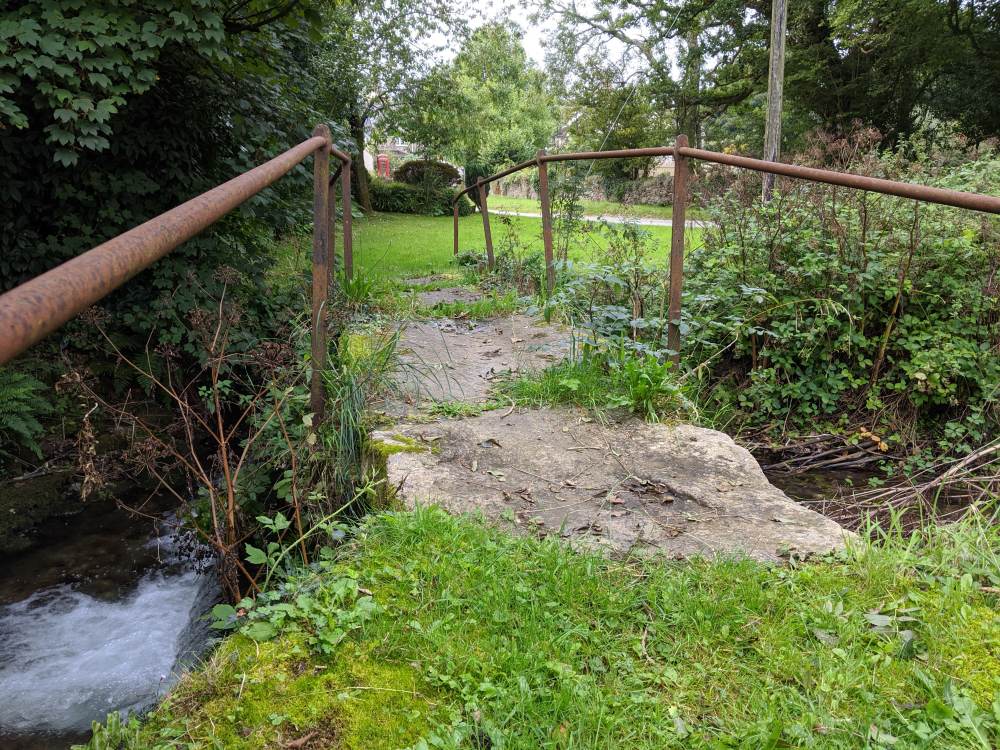
The clapper bridge over the stream. Image from Dartefacts: https://dartefacts.co.uk/dartefact/harbourneford-clapper-bridge/ (10/03/2025).
To be cited as: Hughes, Hannah. 2026. “Understanding de-territorialisation in learning to re-forest our minds”. CAMAMAZON. Available at: https://camamazon.aber.ac.uk/2026/03/10/understanding-de-territorialisation-in-learning-to-re-forest-our-minds/ (accessed xx/xx/xxxx).
In our last blog, Cristina posed the question, is it really possible to “return to the forest”? As we have been writing about foresting (see Inoue et al. 2025), what does it mean to return to the forest?
I wanted to bring Cristina’s questions into conversation with questions that I have been asking myself around de-territorialisation and open this space for other members of the project team to reflect on their own understandings and journeys of multi-territorial living. Looking from myself to other members of the project team, there is a shared relationship of travelling across territories. From the outside at least, it looks like none of us embody a single territory as home. We have each moved and been moved from place to place, and from that respect, it could be said, that we each embody multi-territorial relations and are shaped, in varying ways and degrees, by a dominant world. Thinking through territories with Indigenous scholarship and scholarship working with Indigenous communities has brought the distinction between territorialisation and processes of de-territorialisation into relief.
During COP30 in Belém, Cris and I travelled in an Uber together to the Goeld museum to listen to Davi Kopenawa, an event listed under the SPA schedule. As we got out of the car, I noticed a couple setting up their fruit cart. Set back from the cart, on the pavement, was a flattened cardboard box. Their daughter was young, maybe six, just about to sit and make herself comfortable to wait her parent’s vending out. I noticed that she’d stuck a thick piece of clear tape over her mouth. Maybe she’d peeled it off the side of the box. Seeing her sweet face taped over affected me. I felt my emotion pulling at the edge of me. I carried on past to get into the event.
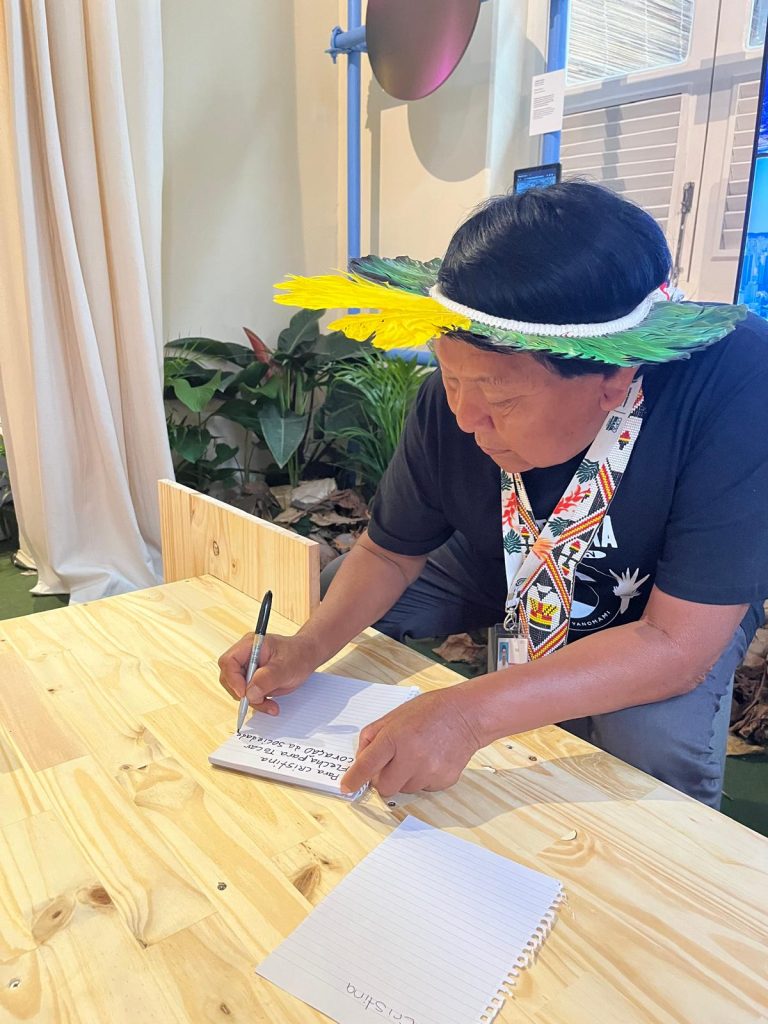
The event was crowded. We hadn’t booked officially, so we had to stand behind carefully placed rows of seating. There was a sense of being inside close, and further back, and we were further back, watching from the perimeter. We tried to get a good spot as close as possible. Cris and I are both short, so we needed to find the right people to stand behind to see between their shoulders. But then I needed translation. A man was handing out headsets, and I left my space to find him.
When I came back, it was even more crowded and I didn’t know how quite to fit in. I tried to squeeze myself back next to Cris’ side. The woman that had taken my place held her ground and Cris gave her a nudge. I felt squashed in between. The emotion that was on the edge moved into the centre and I couldn’t contain it – it welled up and out. The problem is, there is so much emotion that once it begins, it can get away from me. Then I worry about its effect on those around me – I want to get it back in and contained quickly. Cris put her arms around me and it began to subside; I could settle back into my place again, and listen. I closed my eyes to feel only Davi Kopenawa’s words – so that they would sink all the way down into my being and I could return to them later.
His words brought back a theme that had been circling for a while, coming into view as I read Arturo Escobar’s (2008) Territories of Difference: Place, Movements, Life, Redes. Seeing Indigenous relations to territory as a deep and inseparable relation to the land, has brought up questions about how and why I don’t have this relationship – why I don’t feel myself as a continuation of earth-land-sea-sky relations. When and how did I become de-territorialised? Davi Kopenawa’s story of leaving the territory and his view on the city and what it does to people, as Cris described, crystalised this into a question: why did I leave my territory? Why wasn’t I territorialised?
When I was at the COP, I shared with Cris and Verônica one of the stories that had come back to me through questioning my own de-territorialisation. When I was younger, I played in the stream at the bottom of our hill. We lived in a small hamlet of 12 houses or so, amongst farmland owned by various surrounding farms on the edge of Dartmoor National Park. The stream was one of the wild areas between a valley of grass fields, used mostly for grazing sheep, a dairy farm, some straw and hay making. I was concerned about the environment as long as I can remember, and I worried for the land around us. One day, as I walked down our hill, I noticed a farmer releasing brown water into the stream from his muck spreader. I was horrified and helpless.
I felt that the land around me was degrading; being degraded. More roads, more cars, more of everything and a carelessness over it. One of the things that had brought this memory back was reading Escobar’s work on territory and deterritorialization and beginning to question my own relation. I wondered why I didn’t come from a culture that had a relationship to the land – a care for it – why didn’t I stay on that land and struggle for it?
I caught a glimpse of the true enormity of territorial struggle – staying and fighting to keep your relation to land – through Nemonte Nenquimo’s memoir (Nenquimo and Andersen 2024). I was reminded of this, not being Indigenous, during Davi Kopenawa’s talk. Davi held up a distinction between me and him, which was clear as the light of day: he as Indigenous to the forest, and me, a product of a culture that was ravaging his. His was a culture that, contrary to my own experience, could see, hear and care for the trees, the land, the water – it held relation with them. He highlighted a distinct feature of my colonial culture – its de-territorialisation. He pointed out that when the city folk retire they will leave this place and go somewhere else.
Why did I leave the land I loved? Why didn’t I stop it from being degraded and fight to protect what it was and restore it to what it could be? I had to get out, that’s true, I had to grow and live and that wasn’t possible there. I didn’t have the knowledge and the words to convince one farmer, only emotions – care, fear, love – and that wouldn’t have been appreciated. But the problem wasn’t only one farmer dumping his shit into the river; this was happening everywhere, in all rivers – beautiful waterways, some of the wildest places left in the landscape – dirtied with the waste and byproducts of a destructive way of life every day, everywhere. A scale and a problem that I couldn’t encounter in one farmer and one farmer couldn’t counter in himself. I can understand and articulate it now – this is a system problem. I had to leave to learn and to change myself from a product of a destructive system to the possibility of becoming a living one.
This blog is part of a conversation between CAMAMAZON project members on our relationship to the territories of a multi-territorial ethnography. For more in the series, see: Territories.
References
Escobar, Arturo. 2008. Territories of Difference: Place, Movements, Life, Redes. Duke University Press. doi:10.1215/9780822389439.
Inoue, Cristina Yumie Aoki, Verônica Korber Gonçalves, Thais Lemos Ribeiro, Erzsébet Strausz, Hanna Hughes, Esther Wahabu, and Kimberly Marion Suiseeya. 2025. ‘Foresting Global Environmental Politics’. Global Environmental Politics: 1–14. doi:10.1162/GLEP.a.717.
Nenquimo, Nemonte and Mitch Andersen. 2024. We Will Not Be Saved. London: Wildfire.